


Your first well: from idea to commissioning
Start with what you need the water for. Drilling the borehole is only one stage: a working installation also requires checking the yield, choosing the equipment and planning how it will be run.
First, define your needs
Write down whether the well is to supply a house, a garden, a seasonal plot or several uses. Count the users and list the appliances that will run at the same time. Daily water consumption describes the quantity, while the instantaneous flow determines how the installation performs at the hour of peak demand.
Prepare the plot number, the town or village, the approximate location of the water intake and the distance to the building. Make a note of what you do not know yet. The depth of a neighbour's well is a pointer for reconnaissance, not a guarantee of the result on your plot.
Order of work
- Check the location, the intended use of the water and the formalities.
- Agree the scope of the quote, how additional metres are charged and which decisions are made during drilling.
- Prepare the access route, the work area and a way of disposing of the water produced during the work.
- Collect the borehole data and the pumping test results.
- Choose the pump, controls and connection to suit the results and the needs of the water users.
- Order a water test if you plan to use the water in the house; match any water treatment to the results.
- Check that the installation works and collect the equipment documentation.
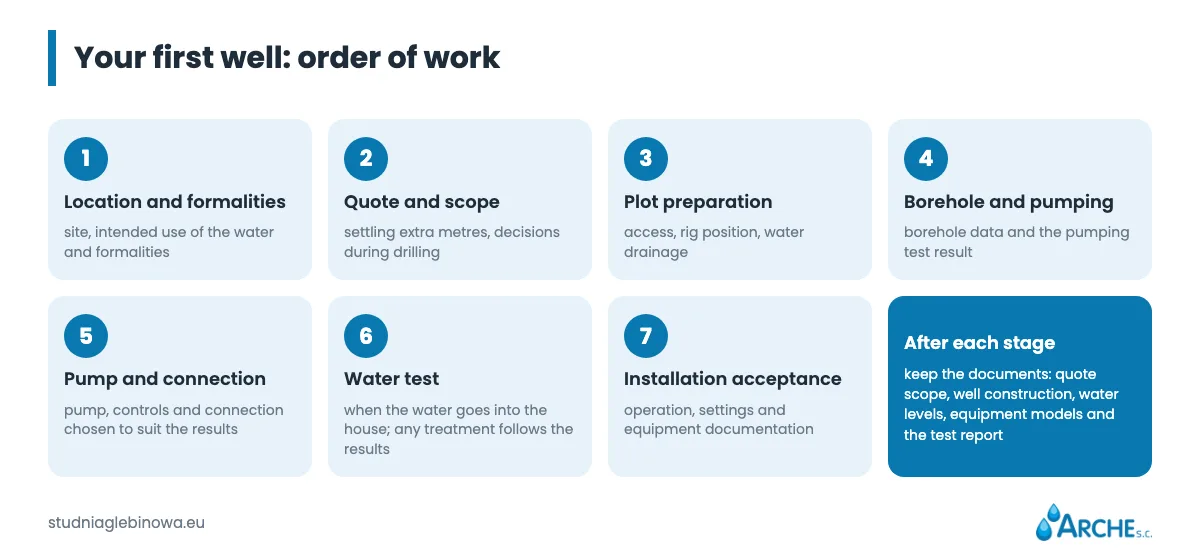
What you should have after each stage
After the quote, keep the scope and the terms of settlement. After drilling, record the well construction, the water levels and the pumping test results. After installation, collect the equipment models, manuals, settings and a description of the valves. After the water test, keep the whole report, with the date and place of sampling.
This way the next contractor works from measurements. They do not have to guess at what depth the pump was set or which part of the installation has already been cleaned.
Plan for maintenance too
In your costs include energy, tests, filter cartridges and the tasks recommended by the manufacturers. Leave access to the pump and fittings. Set inspection dates according to the manual, the test results and the operating conditions, not one calendar for every well.
Sources:
Checked 8 October 2026