


Water testing: laboratory, scope and sampling
A test starts with establishing its purpose and how the sample is taken. A sample poured at random into a household bottle may not give you the answer you need.
Choose the laboratory and the purpose of the test
Say whether you are checking a new intake, water after treatment, a change in smell or an installation after a failure. State the intended use of the water and the history of recent works. Ask for a microbiological and physicochemical scope appropriate to that purpose.
GIS (the Chief Sanitary Inspectorate) reports new requirements for laboratories in force from 21 May 2026. When placing the order, confirm the current accreditation and the accredited scope of testing.
Agree the sampling before the visit
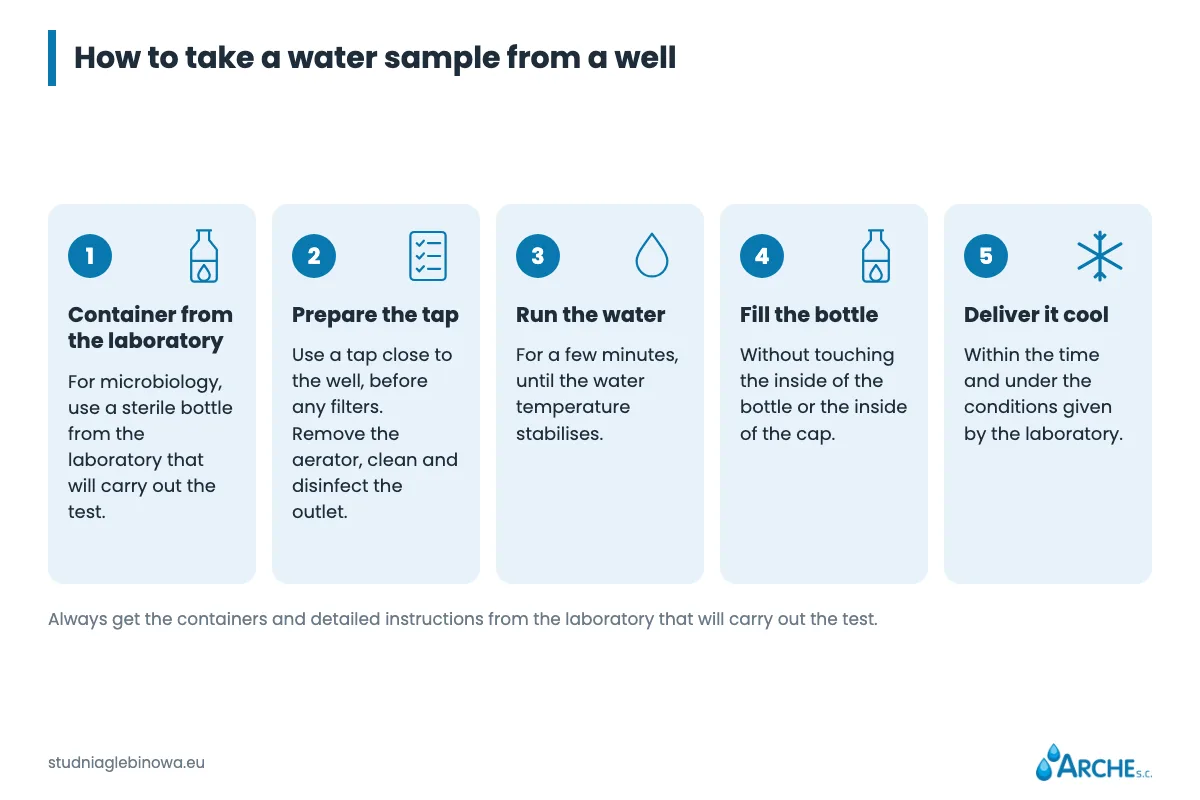
Agree with the laboratory who will take the sample, the containers, the sampling point, how to prepare the tap and transport. Individual determinations may require different containers or procedures. Follow the instructions of the laboratory receiving the sample.
Ask whether the sample is to describe raw water, treated water or water from a specific tap. A sample taken only after the filter will not show the full composition of the water from the intake, and a sample taken before the filter will not confirm that the whole system works.
What information to attach
- The date, time and exact sampling point.
- Information on any filters or disinfection before that point.
- The date the well was commissioned and of the last works on it.
- A description of the problem, for example turbidity appearing after rain.
- The details the laboratory needs to identify the sample.
Plan the next check
Keep the whole report and agree the interpretation with the laboratory. A new result may be needed after a repair, a change of technology or an event that threatens water quality. The timing is agreed to suit the situation, not according to a single fixed schedule.
We do not confirm that water is fit to drink based on its appearance or on a single measurement with a home tester.
Sources:
Checked 8 October 2026