


Is deep well water safe to drink? Testing and values 2026
Is deep well water safe to drink? It can be, but only if a laboratory test confirms it. The depth of the borehole, clarity and lack of smell do not settle the matter, because water contaminated with bacteria can look, taste and smell normal. The test result is assessed against the Regulation of the Minister of Health of 22.05.2026 (Dz.U. 2026 poz. 748), and water treatment is chosen to match what the test shows.
Legal position as at 16.11.2026.
Is deep well water safe to drink without testing
Without a test there is no certainty. A deeper intake is sometimes less exposed to surface contamination than a dug well, but it gives no guarantee: the water can contain natural geological components or the results of human activity, for example a leaking septic tank, fertilisers or run-off from a field.
The State Sanitary Inspectorate (Sanepid) recommends that owners of private wells have the water tested before first use and then at least once a year. Testing is recommended, not mandatory. The owner is responsible for what comes out of the tap, because water from a private well is not covered by regular official monitoring, as described in the notice from the district sanitary station (PSSE) in Sanok on safety rules for water from a private well.
What can be in well water
Contaminants divide into natural ones, resulting from the geological make-up of the area, and those that come from people. The first are most often iron, manganese and hardness; the second are bacteria from leaking septic tanks and nitrates from fertilisers. The two groups are treated with different methods, so you first need to know which one you are dealing with.
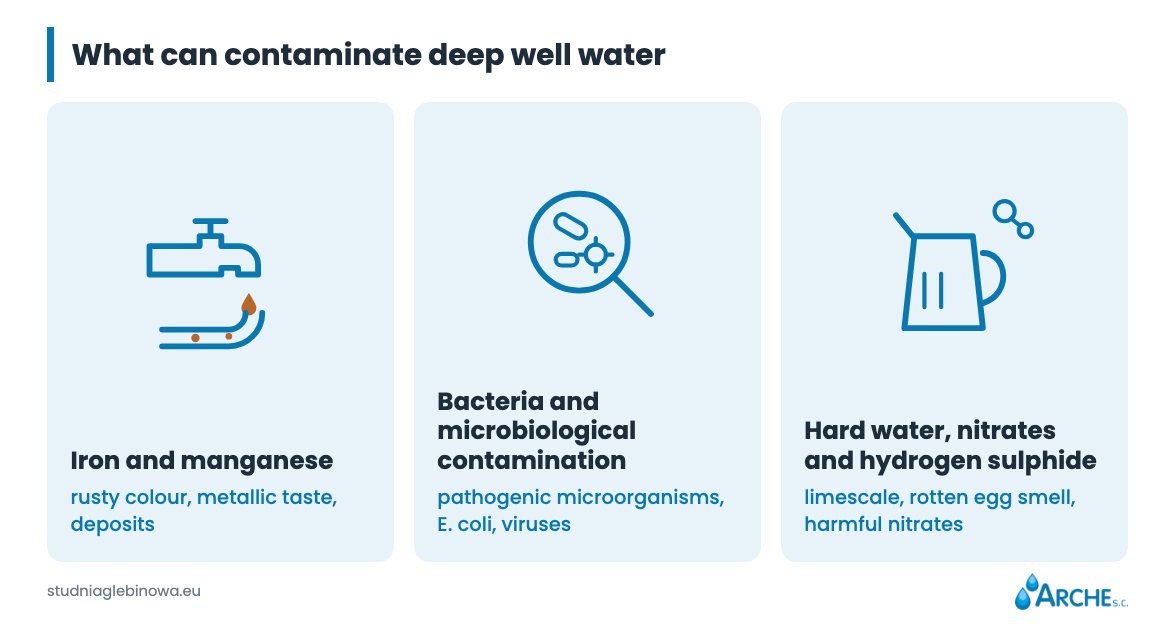
Iron and manganese leave rusty streaks and dark deposits on fittings, and the water can have a metallic taste. Hardness shows up as limescale in the kettle and white marks on taps. Bacteria, including E. coli and enterococci, have no visible symptoms and are detected only by testing. Nitrates come mainly from fertilisers used on surrounding fields and likewise do not change how the water looks.
The smell of rotten eggs is a separate subject, which we cover in the guide well water smells. Smell, however, is proof neither of contamination nor of its absence, so here too the test decides.
Values from the regulation and what to do if they are exceeded
The regulation sets out the quality that water intended for human consumption must have, and it is the reference point when reading a well water test result. The table below gathers the parameters most often checked in a private well.
| Parameter | Value in the regulation of 22.05.2026 | What to do if it is exceeded |
|---|---|---|
| E. coli | 0 in 100 ml (core parameter) | Do not drink the water. Find the cause, disinfect and have a follow-up test. |
| Intestinal enterococci | 0 in 100 ml (core parameter) | The same as for E. coli. |
| Coliform bacteria | Indicator parameter. Isolated results below 10 CFU (or MPN) in 100 ml are permitted if E. coli and enterococci are absent | Discuss the result with the laboratory. If coliform bacteria are detected, E. coli and enterococci should also be tested. |
| Nitrates | 50 mg/l (limit value) | Retest the water and choose treatment to suit the result. Take particular care if small children drink the water. |
| Nitrites | 0.50 mg/l, provided the condition [nitrate]/50 + [nitrite]/3 ≤ 1 is met | As for nitrates. |
| Iron | 200 µg/l, i.e. 0.2 mg/l (indicator parameter) | An iron filter chosen to suit the result. |
| Manganese | 50 µg/l, i.e. 0.05 mg/l (indicator parameter) | Manganese removal, usually together with iron. |
| Ammonium ion | 0.50 mg/l (indicator parameter) | Find the cause with the laboratory, then choose treatment. |
| pH | 6.5 - 9.5 (indicator parameter) | Choose treatment to suit the result, because water with an extreme pH can damage the plumbing. |
| Hardness | 60 - 500 mg/l, a value recommended for health reasons, not a limit | Softening depends on the result and on what the water supplies in the house. |
Indicator parameters describe the practical quality and taste of the water, while core parameters, such as E. coli and enterococci, determine microbiological safety. A value of 0 in 100 ml means that not a single bacterium of that kind can be detected.
When and where to test well water
Test the water when the PSSE recommends it: before first use of a new well and then periodically, ideally at least once a year. An extra test is needed in these situations:
- after a longer break in using the well,
- after a flood, flooding of the plot, the well being inundated or heavy rainfall,
- after a failure of the sewer, septic tank, domestic wastewater treatment plant or water installation,
- when small children, older people, pregnant women or people with weakened immunity use the water,
- when the taste, smell or colour of the water changes.
Testing is done in four steps:
- Choose an accredited laboratory. Some sanitary and epidemiological stations do not accept orders from private individuals, so ask before you go.
- Agree the scope. The minimum is the microbiological parameters (E. coli, enterococci, coliform bacteria) and the physicochemical ones (iron, manganese, nitrates, nitrites, ammonium ion, pH).
- Take the sample exactly as the laboratory instructs. You get the container and the sampling method from the laboratory, because a microbiological sample quickly loses its value.
- Collect the result and compare it with the values in the table above. How to read the individual rows is explained on the page how to read water test results.
Indicative prices, checked 16.11.2026: a “drinking water” package at laboratories is usually PLN 350 - 600 gross, and microbiology alone PLN 100 - 275 gross. We cover the scope and cost of tests separately, and we carry out sampling and the well water test as a service. In the price list, sampling and testing a water sample starts from PLN 1,200 net.
What to do once you have the result
If all values are within the regulation, the water can be considered compliant with the requirements for drinking water on the day the sample was taken. The result applies to that day, which is why testing is repeated periodically.
If any parameter is exceeded, there is no single device for everything. Treatment is chosen to match the result, and you will find a general overview of the methods in the guide well water treatment. The most common scenarios look like this:
- Iron and manganese require an iron filter chosen to suit the concentrations. We cover this in the article iron and manganese in well water.
- E. coli or enterococci bacteria mean that until the water is retested you neither drink it nor use it to prepare food. First the well and the installation are disinfected, and the doses of the agents are chosen according to the article on chlorinating a well. Permanent microbiological protection at the point where water enters the house can be provided by a UV lamp for well water, provided the water is filtered beforehand.
- Nitrates and nitrites above the value in the table call for a separate decision after talking to the laboratory and the water treatment contractor.
Once the equipment is installed, have a follow-up test done. Only that confirms that the treated water meets the values in the table.
Well water versus mains water
It cannot be decided in general which is better. The quality of each source is determined by test results, not by the mere presence or absence of chlorine. Mains water is tested by the supplier, while water from a private well is tested by the owner on their own initiative.
So the cost of your own well has to include testing, servicing and treatment, if the result requires it. We compare cost and convenience in the article well or mains water.
Frequently asked questions
Is drinking deep well water healthy?
Healthy water is water that meets the requirements in a test, not well water as such. We do not give health diagnoses: if you have doubts about your water or the people who drink it, have a laboratory test done and discuss the result with a doctor.
From what depth is well water fit to drink?
There is no depth that guarantees water fit to drink. Water from deeper layers is sometimes better protected from surface contamination, but it can contain more natural iron and manganese. Whether the water is suitable is decided by testing a sample from the particular well.
Can you drink well water without testing it?
We do not recommend it. Water can look and smell normal and still contain bacteria you cannot see. Sanepid recommends testing before the first use of a well and periodically while it is in use.
Is it enough to boil well water?
Not always. According to the PSSE, boiling can reduce the microbiological risk, but it does not remove all contaminants, for example nitrates or heavy metals. Discuss water for infants with a doctor and do not use untested well water for it.
Is testing well water mandatory?
For a private well used for your own needs we found no statutory obligation to test, and Sanepid recommends it. The monitoring obligations in the regulation apply to water suppliers. Have the water tested anyway, because responsibility for the quality of the water at the tap rests with the well owner.
Sources
- Rozporządzenie Ministra Zdrowia z 22.05.2026 w sprawie jakości wody przeznaczonej do spożycia przez ludzi, Dz.U. 2026 poz. 748 (parametric and indicator values, tables in parts B, C and D)
- PSSE w Sanoku: woda z prywatnej studni, podstawowe zasady bezpieczeństwa (when to test, boiling water, groups needing special attention)
Want to find out what is in the water from your well? Write to us or call: +48 784 038 407. We will agree the scope of the test and, if the result requires it, choose treatment.
