


What pump for a deep well? Sizing for 20, 30, 50 and 100 m
What pump for a deep well? A submersible pump chosen to match three figures: the pumping head, the flow the well can sustain and the diameter of the well casing. The pumping head is the depth of the water level during pumping, the height to the highest tap, the pressure at the tap and the losses in the pipes. Below is a sizing table for wells 20, 30, 50 and 100 m deep, and a way to recalculate it for your own well.
What pump for a deep well: three figures to size it
You size a pump to the well, not to the depth of the borehole. First establish these three figures, and only then look for a model.
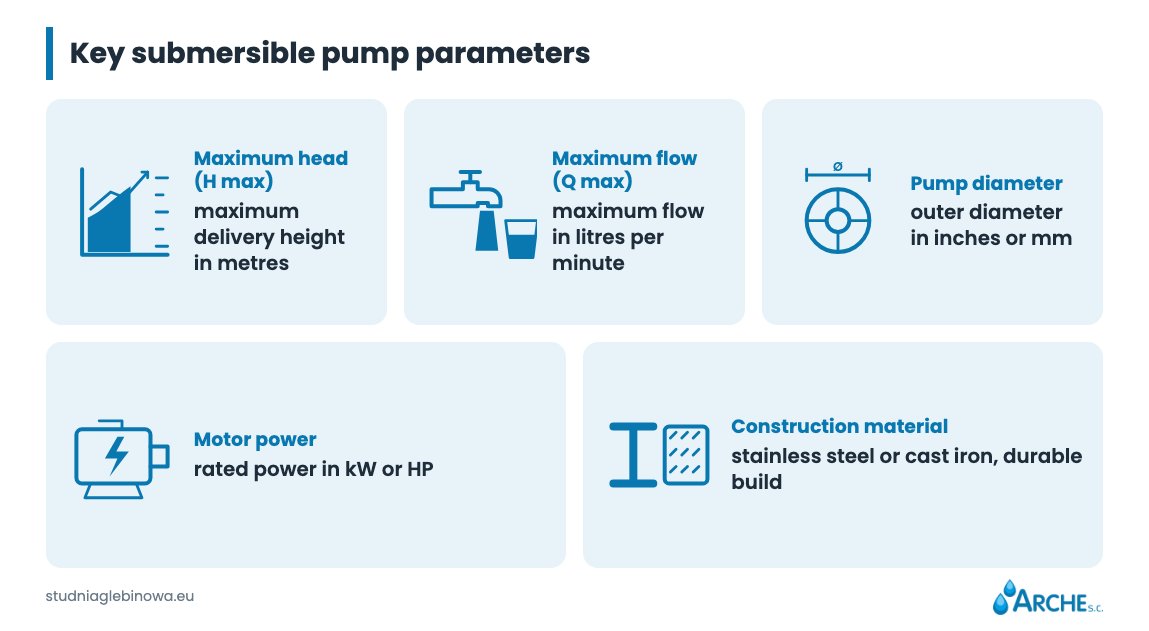
- The pumping head. The manufacturer Grundfos describes it in its course on sizing well pumps as a sum: the height and losses from the dynamic water level to the tank, from the tank to the highest tap, plus the minimum pressure at the tap.
- The flow. It depends on how many taps, appliances and how much garden watering you want to serve at the same time. It cannot exceed the safe abstraction from the well, which the pumping test establishes. We explain how to read it in our article on deep well yield.
- The diameter. The pump must fit in the well casing with room to spare for the cable and for water to flow around the motor.
A pump that is too small will give too little flow or pressure, while one that is too large runs at low energy efficiency, as the same Grundfos course points out. The pump must also sit below the dynamic water level, not the static one: it is the dynamic level that drops when the pump draws water.
Pump sizing table for wells 20, 30, 50 and 100 m
The table is a worked example, not a substitute for a pumping test. The dynamic level in the second column is an assumption. In a real well you will measure it during the pumping test. Further on, 40 m is added to the water level: 5 m to a tap located higher up, 30 m for a pressure of 3 bar and 5 m for losses in the pipe.
| Well depth | Assumed dynamic level | Pumping head (water level + 40 m) | Example pump class |
|---|---|---|---|
| 20 m | 12 m | 52 m | 4SR 2/12, 0.75 kW, 66 m at 40 l/min |
| 30 m | 20 m | 60 m | 4SR 2/12, 0.75 kW, 66 m at 40 l/min |
| 50 m | 35 m | 75 m | 4SR 2/17, 1.1 kW, 94 m at 40 l/min |
| 100 m | 80 m | 120 m | 4SR 2/23, 1.5 kW, 127 m at 40 l/min |
The pump class column shows how to read the curves and is not a brand recommendation. The head values come from the datasheet of the Pedrollo 4SR series at an assumed flow of 40 l/min. The pump has a margin, because the head from the curve (66 m) is greater than the head needed (52 or 60 m). At a different flow the head from the curve will be different: at 20 l/min the same 2/12 pump gives 84 m, so the less water you need, the higher it will lift it.
Do not choose a pump by the Hmax value on the plate alone. Maximum head and maximum flow do not occur at the same time: the greater the flow, the lower the head, and the other way round. Compare the operating point, that is, the head you need at the flow you need, on the manufacturer’s chart.
A 30 m well: the calculation step by step
In a well 30 m deep, the dynamic level may be at 20 m, but that is a value from the example. Take your own figures from the pumping test.
- To the dynamic level (20 m), add the difference in height to the highest outlet, for example 5 m.
- Add the pressure you want at the tap. 3 bar corresponds to about 30 m of water column.
- Add the losses in the pipe, 5 m in the example. They grow with a long run and a narrow pipe.
- The result is about 60 m. Look for a pump whose chart shows at least 60 m at the flow you want to achieve.
When the well is 30 m deep but the dynamic level is lower, for example 28 m, the same pump will no longer be enough: the pumping head will rise, and the pump must not run without water. That is why the depth of the borehole alone decides nothing.
What pump power is enough
The motor power follows from the sizing, not the other way round. Once you know the head and flow you need, the manufacturer states which motor drives the pump. In the datasheet for the 4SR 2 series, at a flow of 40 l/min the head rises with the power: 49.5 m at 0.55 kW, 66 m at 0.75 kW, 94 m at 1.1 kW, 127 m at 1.5 kW and 182 m at 2.2 kW.
A simple rule follows from this: the deeper the water level and the higher the outlets, the greater the power, but there is no single kW figure for a well of a given depth. Two wells 30 m deep may need pumps of different power if they have a different dynamic level or a different house.
The water also affects the choice. For the 4SR series, the Pedrollo datasheet gives a liquid temperature of up to +35 °C and a sand content of up to 200 g/m3 for the 4SR-S version and 150 g/m3 for the 4SR-N version. Sand wears down the impellers, so in a well that produces sand, the pump’s resistance and a properly made screen matter more than power alone. The pump also should not run dry. Some models have dry-run protection, for example Grundfos SQ pumps according to the manufacturer’s brochure.
Pump diameter of 3 and 4 inches and the well casing
The pump must have a smaller outside diameter than the inside diameter of the casing, but not much smaller. In its course, Grundfos gives a rule of thumb: the nominal diameter of the pump should match the diameter of the borehole, and an oversized borehole risks overheating the motor, because the water flows past it too slowly. The Pedrollo datasheet requires a flow of at least 8 cm/s around the motor and offers a cooling jacket as optional equipment.
According to the brochure, 3-inch pumps, such as the Grundfos SQ, are intended for wells of 3 inches and larger. According to the datasheet, 4-inch pumps, like the 4SR series, require a well of at least 4 inches, that is 100 mm, and the unit itself has an outside diameter of 98 mm. So check the inside diameter of the casing, not only the outside one. PVC-U well casing in our boreholes is usually 125 mm, and in sandy ground 110 mm with a thicker gravel pack. How the casing diameter relates to the pump is covered in our article on the diameter of a deep well.
Power supply: 230 V or 400 V, single or three phase
The voltage and number of phases follow from the house connection, not from the depth of the well. The same series is often available in both versions: the Pedrollo 4SR datasheet describes three-phase 400 V motors and single-phase 230 V ones (model 4SRm), in the same powers from 0.37 to 2.2 kW, and the starting capacitor for the single-phase version is in the box. According to the brochure, Grundfos SQ pumps have built-in control, need no starter and run on a single-phase supply in the range of 150 - 280 V.
If the house has only one phase, you choose the 230 V version. If it has three phases, you can choose either version, and other things decide: protection, control and cable length. Connecting the pump to the power supply is done by a qualified electrician. This article does not describe the wiring diagram.
Look at the cable too. The Pedrollo datasheet gives a 2 m cable for powers of 0.75 - 2.2 kW, so for a deep well it has to be extended, or you need to choose a set with a longer cable.
What this sizing does not cover
Pump sizing ends at the pump. We cover the rest of the installation separately:
- the tank and pressure switch are covered in our article on the pressure tank for a deep well,
- constant pressure and a soft start are provided by a variable frequency drive for a submersible pump,
- you will find a comparison of a submersible pump with a pressure booster pump in the article pressure booster pump or submersible pump.
Step-by-step help with sizing, with questions about the house and the well, is in the Help Centre: pump selection.
Once the pump is chosen, we carry out its submersible pump installation. According to the price list, it costs PLN 700 net plus materials.
Frequently asked questions
How do you choose a submersible pump for a well?
Calculate the pumping head: the dynamic water level, the height to the highest tap, the pressure at the tap and the losses in the pipes. Then establish the flow the well can sustain, and find a pump whose chart shows that head at that flow. Finally, check that the pump fits in the well casing.
What pump power does a deep well need?
There is no single power for a given depth. The power follows from the pumping head and the flow. In the datasheet for the 4SR 2 series at 40 l/min, a 0.75 kW pump gives 66 m and a 1.5 kW pump gives 127 m. For a 30 m well with a dynamic level of 20 m (the example from the table), the 0.75 kW version is enough with a margin.
Which submersible pump should you choose: 230 V or 400 V?
It depends on the connection in the house. If you have one phase, you choose the 230 V version. If you have three phases, you can choose either version, and protection and control decide the choice. The connection is made by an electrician.
Which is better, a single-phase or a three-phase submersible pump?
Neither is better in itself. Manufacturers, for example Pedrollo, offer the same series in both versions and in the same powers. The single-phase version needs a capacitor, and the three-phase one needs three phases in the house. Choose the one that suits your electrical installation.
Will a 4-inch pump fit in a 100 mm well?
According to the Pedrollo datasheet, the 4SR series is intended for wells of at least 4 inches, that is 100 mm, and the unit has an outside diameter of 98 mm. That is a margin of the order of millimetres, so measure the inside diameter of the casing and check that the cable and the motor cooling have room. If the casing is narrow, choose a 3-inch pump.
Can a submersible pump run non-stop?
According to the Pedrollo datasheet, the 4SR series is rated for continuous duty S1 and allows up to 20 starts per hour at equal intervals. That is what the pump can do, not what the well permits: the pump must not draw more water than the well gives, because then the water level drops and the pump sucks in air.
Sources
- Grundfos eCademy: pump sizing and installation in domestic groundwater applications (Grundfos SQ and SQE)
- Grundfos: SQ and SQE pump brochure (April 2023)
- Pedrollo: datasheet for 4SR-S and 4SR pumps, 50 Hz
Have a well and not sure which pump suits it? Write to us or call: +48 784 038 407. We will ask for the depth of the well, the result of the pumping test and the type of power supply in the house.
