


Deep well diagram: what it consists of and what the cross-section looks like
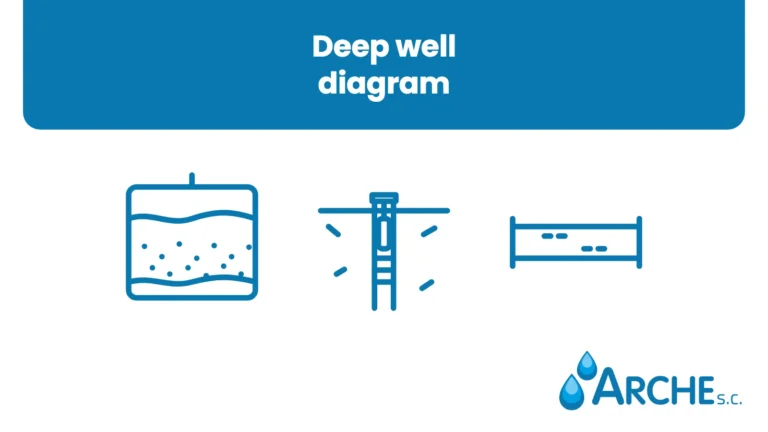
A deep well diagram shows a vertical borehole with a well pipe, a well screen and gravel pack at the bottom, in which a submersible pump supplies water through a rising main to the house. At the top the borehole is closed by a cover or a wellhead, and in the building there is a pressure tank (hydrophore) with controls. Below we go through this cross-section from top to bottom, element by element. The principle of operation is covered in the article how a deep well works, and the order of work on a borehole in deep well construction step by step.
Want to click and see the elements on the drawing? Use the interactive well diagram. We have also collected descriptions of the elements with their parameters in the Help Centre: well components: pipes, screen, gravel pack and wellhead.
Deep well diagram in a single table
From the surface to the bottom, a well consists of: a cover or enclosure, a wellhead or adapter, a well pipe with a screen and gravel pack, a pump with a rising main, a support cable and a power cable, and a pressure tank (hydrophore) in the building. The table shows what each does and what values you meet in practice.
| Element | What it is for | Typical parameter |
|---|---|---|
| Cover or enclosure | Shields the pipe outlet from rainwater, dirt and frost | With a pitless adapter (Swedish coupling) solution, a compact cover about 30 cm above ground |
| Wellhead or adapter | Seals the outlet of the well pipe and the pass-throughs for the rising main and cable | A pitless adapter is installed below the frost line, in DN 110 - DN 160 pipes |
| Well pipe | Keeps the borehole open and carries water to the pump | At ARCHE PVC-U 125 mm, in sandy ground 110 mm |
| Casing | Temporarily supports the walls during drilling | At ARCHE it is pulled out after the well pipes are installed |
| Screen pipe | Lets water in from the aquifer and holds back sand | A section with holes or slots, its length chosen to suit the thickness of the aquifer |
| Gravel pack | Stabilises the pipe and acts as an additional filter | Gravel or grit of a chosen grain size, coarser in sand |
| Submersible pump | Lifts water to the surface | Submerged in the water, above the bottom of the well |
| Rising main | Carries water from the pump to the well outlet and on to the house | Most often a PE pipe |
| Support cable and power cable | The support cable holds the pump, the power cable supplies it | A stainless steel support cable, with the power cable run along the rising main |
| Pressure tank (hydrophore) and pressure switch | Maintain pressure in the system and switch the pump on | A diaphragm tank, with the pump’s switch-on and switch-off thresholds set on the pressure switch |
What is above ground: the cover, enclosure and wellhead of a deep well
Above ground you see only the cover, and under it the wellhead or adapter, the part that closes the borehole and lets the rising main and cable through. A well-made wellhead keeps rainwater and contaminants out of the well pipe. There are two solutions on the market: a classic enclosure with a wellhead, and a pitless adapter. In the second case the manufacturer describes an adapter installed below the frost line and a low cover with an electrical connection for the pump, without a traditional enclosure (manufacturer’s page, Gamrat: złącze szwedzkie).
Which variant to choose and how to make the protection is covered in the article on the deep well wellhead.
What is in the borehole: pipes, screen and gravel pack
In the borehole stands the well pipe, and in its lower part a screen pipe surrounded by gravel pack. The well pipe is the skeleton of the well: it stops the walls from caving in and carries water to the pump. ARCHE installs PVC-U pipes with a diameter of 125 mm, and in sandy ground 110 mm with a coarser gravel pack. During drilling the walls are supported by casing, which we pull out once the well pipes are installed.
The screen has holes or slots at the point where the borehole cuts through the aquifer. Water flows in through them, and most of the sand stays outside. The space between the pipe and the borehole wall is filled with a gravel pack: it stabilises the pipe and holds back fine particles. If the screen or gravel pack is badly chosen, sand reaches the pump and wears out its impellers. That is why the final check after installation is a pumping test.
Choosing the diameter and material of the pipes is a separate topic: see which pipe for a deep well suits the pump and the ground.
Pump, rising main, support cable and power cable
A submersible pump hangs on a cable in the well pipe, below the water level, and pushes water up the pipe. The rising main, the power cable and the support cable run together from the pump to the wellhead. The support cable takes the weight of the pump, so it puts no load on either the pipe or the power cable. The pump is fitted above the bottom of the well so that it does not draw in sediment, and usually with a reserve of water above it, including when the water level drops during pumping.
The yield and lift height the pump needs are determined by the depth of the well, its yield and the needs of the house. We describe them in the article which pump for a deep well.
The aquifer: where the well gets its water
A well draws water from an aquifer, that is, sand, gravel or rock saturated with water, lying between layers of low permeability. Water flows from it into the screen pipe until the static level settles. When the pump runs, the level drops to the dynamic level and settles where inflow balances abstraction.
On the diagram it is the deepest element, but there is no single depth for every plot. It depends on the local ground structure, so the depth of the borehole is decided by investigating the site, not by a table. The depth pages in our offer start at 15 m and end at 100 m.
What is in the house: pressure tank, pressure switch and controls
In the building there is a pressure tank (hydrophore) and a pressure switch, and sometimes a variable frequency drive. The pressure tank stores water under the pressure of compressed air on the other side of the diaphragm, so the pump does not start every time a tap is turned on. The pressure switch starts it when the pressure falls below the lower threshold and stops it when the upper one is reached. Sets with a variable frequency drive smoothly change the pump speed instead of start-stop operation. We install sets with a variable frequency drive and with a pressure switch.
From the diagram to your own well
The diagram is the same, but the equipment depends on the ground, the depth and the needs of the house, and when planning it is also worth checking which permits and notifications apply to the intake. The Water Law Act lists exemptions from a permit that depend on depth and the volume of water abstracted (Article 395, Prawo wodne, consolidated text Dz.U. 2026 poz. 1335), but it does not remove siting requirements and other regulations.
ARCHE drills deep well boreholes in Lesser Poland (Małopolska) and Silesia: well borehole drilling covers drilling, pipes, a screen with gravel pack and a pumping test, and the work comes with a 2-year guarantee.
Want to plan a well for your plot? Contact an ARCHE expert. We call back within 24 hours.
Frequently asked questions
What does a deep well consist of?
A well pipe with a screen and gravel pack, a submersible pump with a rising main, a support cable and a power cable, a wellhead or adapter at the top, and a pressure tank (hydrophore) in the building. The table at the start of the article describes these elements. In practice there are also a non-return valve, a pressure gauge and power supply protection.
Where does a deep well get its water?
From an aquifer, that is, sand, gravel or rock saturated with water, which the borehole reaches. Water flows through the screen into the well pipe, and the pump lifts it to the surface. The depth of this layer depends on the plot.
From what depth is a well a deep well?
There is no single boundary by definition. A deep well is a drilled well that reaches aquifers deeper than a dug well does. The 30 m threshold in the Water Law Act concerns the exemption from a permit, not what the well is called. The depth pages in our offer start at 15 m.
Where is the pump, and where is the pressure tank?
The pump is in the well, submerged below the water level. The pressure tank (hydrophore) with the pressure switch stands in the building or in a utility room, so it does not freeze and is easy to operate. They are linked by the rising main and the power cable.
Is a deep well diagram the same for every house?
The principle is the same, but the diameter of the pipes, the length of the screen, the gravel pack, the type of pump and the way the well is closed depend on the ground, the depth and water use. That is why they are decided for the specific plot before drilling.
Sources
- Gamrat: złącze szwedzkie: the manufacturer’s description of how a pitless adapter and a low cover replace a classic enclosure (checked on 16.11.2026).
- Prawo wodne, consolidated text Dz.U. 2026 poz. 1335: Article 395 on exemptions from a water-law permit and notification (checked on 16.11.2026).
