


How to read water test results
Read the whole report, including the sampling point, the units and the assessment. A single number without this information can lead to a wrong conclusion.
Check what the result refers to
Compare the address, sample identifier and date with your own order. See whether the sample was taken before the treatment equipment, after it or from a specific tap. Check who took the sample and what purpose was agreed.
The result refers to the sample tested and the time it was taken. It is not an indefinite guarantee for the whole installation. After a significant change in conditions, a new assessment may be needed.
Do not mix up units and ranges
Pay attention to mg/l and µg/l and to how microbiological results are written. The symbol "<" means a result below the stated limit, not an arbitrarily assumed zero. Do not copy just the number into the record without the unit.
Comparison with the requirements should refer to the current regulations and the intended use of the water. Ask the laboratory which criteria it applied. Do not decide the overall suitability of the water from hardness, pH or a conductivity meter.
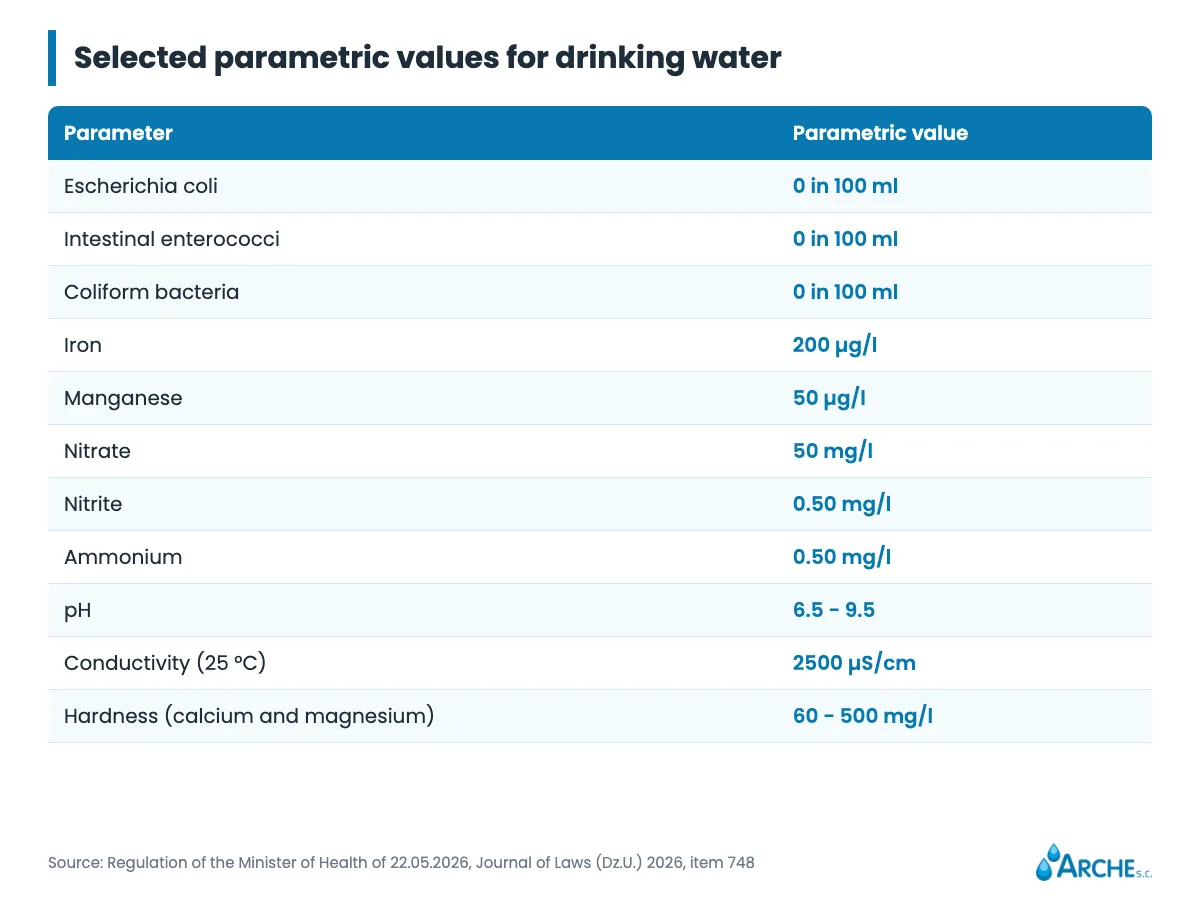
Parameter and the next decision
| Area of the result | Question for the specialist |
|---|---|
| Microbiology | How should the water be handled, and does the source of contamination need to be identified? |
| Iron, manganese, turbidity | How do the results together affect the need for treatment and the choice of technology? |
| Hardness, pH and other chemistry | What do they mean for the installation and the planned use? |
| Parameter out of range | Does the purpose of the test require an additional determination? |
Write down the plan once you have the result
Separate the decision on whether to use the water from the design of the equipment. Keep the recommendations of the laboratory or the relevant sanitary inspection station. If remedial work is needed, write down who is responsible and how the result will be confirmed later.
We do not give individual health advice here, and we do not declare water safe on the basis of the colour of the sediment.
Sources:
Checked 8 October 2026