


Well water smells: causes of the smell and what to do
When well water smells, the most common cause is hydrogen sulphide (a rotten egg smell), iron and manganese (a metallic, rusty taste) or bacteria breaking down organic matter (a putrid smell, sometimes like a septic tank). The smell only points you in a direction and confirms nothing. A definite answer comes from a laboratory water test, and only after that do you choose a filter, aeration or disinfection.
Well water smells: the smell points to the likely cause
Each smell narrows the list of suspects, but none is proof. The table below shows where to start. The “Test” column says what to ask the laboratory for, and you should agree the full scope with them before taking the sample.
| Smell or symptom | Likely cause | Test | What usually helps |
|---|---|---|---|
| Rotten eggs | Hydrogen sulphide, sulphate-reducing bacteria | Hydrogen sulphide, physicochemical, bacteriological | Aeration, an activated carbon filter, an iron filter with aeration |
| Metallic, rusty colour, stains on fittings | Iron and manganese | Iron, manganese, ammonium | Iron and manganese filter |
| Putrid, like a septic tank | Bacteria, contamination from the surface or from sewage | Bacteriology (E. coli, enterococci), ammonium, nitrates | Finding the source, disinfection, treatment once you have the result |
| Chemical, petroleum-like | Substances from the ground or from activity nearby | Scope set by the laboratory | Do not drink. Identify the source first |
| Chlorine | Residue after disinfection | Usually no test, the smell goes away after pumping out | Pump out the water until the smell is gone |
| Earthy, musty | Organic matter, water standing after a period of disuse | Bacteriology, physicochemical | Pumping through, testing, then a decision on treatment |
| Hot water only | Water heater or hot water system | Service check of the water heater | Service the water heater according to the manufacturer’s instructions |
Several causes can occur at once. Hydrogen sulphide very often accompanies iron and manganese, so a single filter is often not enough. The order of equipment in a treatment system is described in the guide on treating well water. Identifying a problem by smell is also covered on our help page: unusual water smell in the Help Centre.
Well water smells like rotten eggs: hydrogen sulphide
A rotten egg smell is most often hydrogen sulphide (H2S), a gas produced when anaerobic bacteria reduce sulphates in water that has no oxygen. These conditions exist in deeper aquifers, so the problem also affects clean, deep wells.
Hydrogen sulphide speeds up the corrosion of pipes and fittings. A black deposit on the bottom of the well or on fittings is often iron sulphide and points to hydrogen sulphide, but only a test confirms it. The problem gets worse in summer and after a long period of disuse, when the water stands without any oxygen.
Is it the well or the water heater?
If only the hot water smells and the cold water has no smell, suspect the water heater. In storage tanks anaerobic bacteria can be active, especially around the magnesium anode. If both cold and hot water smell, the cause is in the well or in the aquifer. Carry out any anode replacement and thermal disinfection according to the manufacturer’s instructions, because hot water causes scalds. A smell in the hot water alone does not give a definite diagnosis, so if in doubt, have it checked by a service technician.
How hydrogen sulphide is removed
Hydrogen sulphide is removed by oxidation or adsorption, and the method is chosen according to its concentration and what else is in the water. The diagram below shows four solutions used in practice.
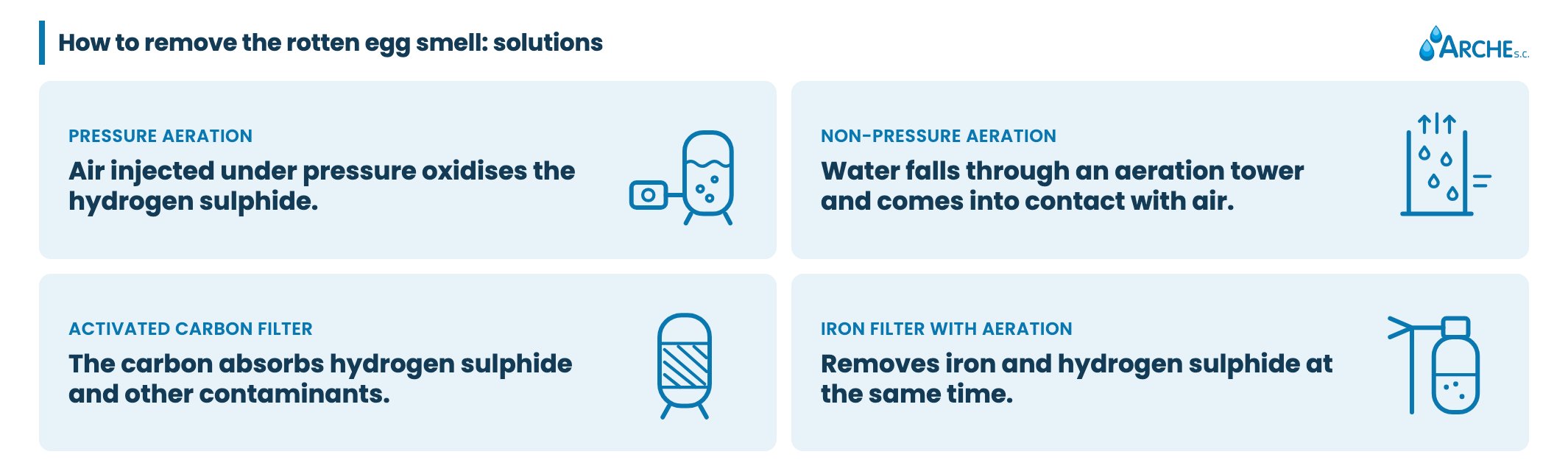
Pressure aeration forces air into a tank, while atmospheric aeration uses a tower or contact tank and takes up more space. An activated carbon filter works at low concentrations but needs the bed replaced regularly, and where there is a microbiological risk it does not replace disinfection. When the water also contains iron and manganese, an iron filter with aeration is considered. The specific equipment, its size and its cost depend on the test result and the flow rate in the house, so we give no prices here. We will prepare an indicative quote after the test.
Well water smells like a septic tank: bacteria and contamination
Treat a putrid smell, or one like a septic tank, as a warning sign: until you have the test result, do not drink the water or use it to prepare meals. It may mean bacteria from the surface or from sewage, but it is just as often the result of hydrogen sulphide or standing water. A bacteriological test settles it.
Microbiological contamination is usually caused by:
- a leaking wellhead, cover or well enclosure, letting in rainwater, leaves or small animals,
- a damaged well casing or joints, allowing in water from higher layers,
- a nearby source of contamination, e.g. a waste tank, an animal run or a leaking septic tank,
- a rarely used well in which the water stands for months.
Distances from a septic tank and the plot boundary are currently an open question: the previous regulation on technical conditions ceased to apply in September 2026. We describe the details and the previous values in the article on the distance of a well from a septic tank, and the location is agreed with the designer and the district office (starostwo).
What to do if the water smells like a septic tank
- Stop using the water for drinking and cooking.
- Order a bacteriological test at a laboratory. For microbiology you need a sterile container from the laboratory, and the laboratory gives the transport time and temperature.
- Check that the cover, wellhead and enclosure are watertight.
- Once you have found the cause, consider disinfection. Without removing the source of contamination it is only a stopgap.
- After disinfection, confirm the effect with another test. The smell alone is not enough.
The principles of disinfection are set out in the State Sanitary Inspectorate (Sanepid) instructions on cleaning and disinfecting wells: chloramine or sodium hypochlorite solutions are used for disinfection, and the water must not be used while disinfection is under way. Doses and contact time depend on the volume of water, the product and the construction of the intake, so we do not give them here. The details are in the article on chlorinating a deep well. In a drilled well it is hard to spread the agent evenly, so it is better to leave the procedure to a service company. We carry out cleaning, inspection camera surveys and disinfection as part of the services described in the guide on well cleaning and servicing.
Metallic smell and rusty water: iron and manganese
A metallic taste, a rusty colour, yellow streaks on fittings and stains on laundry are typical symptoms of iron and manganese. They are natural components of groundwater, leached from the ground, so their presence does not mean the well was built wrongly.
Legal position as at 16.11.2026: according to the Regulation of the Minister of Health of 22.05.2026 (Dz.U. 2026 poz. 748), for water intended for human consumption the indicator parameter value is 200 µg/l (0.2 mg/l) for iron, 50 µg/l (0.05 mg/l) for manganese and 0.50 mg/l for ammonium. These are indicator parameters, and water from deep wells often exceeds them. The solution is treatment, and the choice of equipment depends on the concentrations in the test, e.g. whether the water contains only iron or also manganese and hydrogen sulphide. The details are in the article on iron and manganese in well water.
How to test the water when your well water smells
Water testing is recommended, not mandatory: the owner of a private well has no statutory duty to test, but Sanepid recommends testing before first use, at least once a year, and after flooding and failures. If there is a new smell, it is worth doing so straight away.
Before you go to the laboratory, you can narrow the problem down with three simple observations:
- Compare the smell of cold and hot water.
- Check whether the smell appears after a longer period of disuse and goes away after a few minutes of pumping.
- Note down since when this has been going on and whether anything has changed: a failure, flooding, a pump replacement, cleaning.
These observations do not confirm the cause or the safety of the water, but they help the laboratory and the service technician. Water quality is not judged by smell alone, and the wellhead should not be opened unnecessarily.
We take and test water samples as part of our well water testing service: in the price list the item starts from PLN 1,200 net, and laboratory testing alone costs about PLN 400. For comparison, market prices for tests (checked on 16.11.2026) are roughly PLN 100 - 600 gross depending on scope, from commercial sources.
Can you drink water that smells?
Until you know the cause and have the test result, it is better not to drink it. The smell of hydrogen sulphide does not in itself mean bacterial contamination, but you cannot judge that without a test, and a putrid smell may point to microbiological contamination. The standards and rules for assessing whether water is fit to drink are covered in a separate article: whether water from a deep well is drinkable. In short: drinking water must contain 0 E. coli and enterococci in 100 ml, and the test result, not smell or appearance, decides whether it is fit to drink.
When a filter is not enough
A filter solves the problem with the water, but it does not repair the well. If a test or an inspection camera points to a damaged casing, a leak, silting or a destroyed well screen, you first need to remove the cause and then choose treatment. Where the aquifer is permanently contaminated, treatment alone may not be enough. Whether repair, cleaning or a new borehole is justified is assessed after diagnostics of the particular well.
How to prevent a smell in the water
- Test the water at least once a year and after every failure or flooding.
- After a pump replacement, cleaning or flooding, consider disinfecting the well and confirm the effect with a water test.
- For a seasonal well, pump it through after winter before first use and watch the smell.
- Check the cover and enclosure for tightness every few months.
- Replace filter beds and the light source in the UV lamp according to the manufacturer’s instructions.
If the water in your well has changed smell and you want to find the cause, book a water test and a conversation with an expert. We will agree the scope of the sample and the next steps after the result.
Frequently asked questions
Why does well water smell like rotten eggs?
Most often because of hydrogen sulphide (H2S), which is produced when anaerobic bacteria break down sulphur compounds in water without oxygen. The smell is distinct even at a low concentration. It is removed by aeration, an activated carbon filter or an iron filter with aeration, depending on the test result.
Why does well water smell like a septic tank?
It may be contamination with bacteria from the surface or from sewage, but also hydrogen sulphide or water standing after a period of disuse. Until you have the bacteriological test result, do not drink the water. Check that the cover and enclosure of the well are watertight, and look for sources of contamination nearby.
Is well water that smells dangerous?
The smell alone does not settle that. Hydrogen sulphide can be a nuisance and harms the installation, and a putrid smell may go with microbiological contamination. So until you have the water test result, do not drink it or use it for cooking.
Why does only the hot water have an unpleasant smell?
It is usually a sign that the problem lies in the water heater or the hot water system, not in the well. It is not a definite diagnosis. Have the water heater checked by a service technician and follow the manufacturer’s instructions, because hot water can scald.
Is an activated carbon filter enough for the smell of well water?
Sometimes it helps with low concentrations of odour-causing contaminants, but it is not a stand-alone protection against microbiological contamination. The need for a UV lamp and the order of equipment are decided after a water test.
Why does well water smell after winter?
After a long period of disuse the water stands in the well and pipes without oxygen, which favours anaerobic bacteria. Pumping the well through before first use often helps. If the smell does not go away, order a water test and consider disinfection.
Sources
