


Well water testing: scope, standards, price and sampling
Testing the water from your well is the only way to know whether it is safe to drink and whether it needs treatment. The minimum is a microbiological test (E. coli, enterococci, coliform bacteria) plus a basic physicochemical panel: iron, manganese, nitrates, nitrites, ammonium, pH, hardness, turbidity and conductivity. A package for a domestic well usually costs from about PLN 300 to 900 at a laboratory, depending on the scope and the region.
Whether the water from your well can go into a cup is covered in more detail in our article on drinking well water. Here we focus on the test itself: when to do it, what to test for, what it costs and how to take the sample.
When to test the water from your well
A test is worth doing in several situations:
- after a new well has been completed, once the water has been pumped out and has stabilised,
- after cleaning or disinfecting the well, as a follow-up test,
- periodically, if the water is used for drinking,
- after flooding, repair of the wellhead, replacement of the pump or work on a septic tank nearby,
- when the taste, smell or colour changes, or sediment appears.
Clear water with no smell is not necessarily safe. You cannot see bacteria and nitrates with the naked eye. The depth of the borehole does not settle the question of quality either, because that depends on the aquifer and on how well the water source is sealed.
Which parameters to test
It helps to split the scope into two parts.
The microbiological test answers the question of whether the water contains bacteria that indicate contamination, for example by sewage. The most important are E. coli and intestinal enterococci, together with coliform bacteria and the total colony count at 22 °C.
The physicochemical test shows what is dissolved in the water. For a domestic well, the typical scope is iron, manganese, nitrates, nitrites, ammonium, pH, hardness, turbidity, colour, smell and conductivity. The results from this part determine the choice of equipment, which we describe in our article on treating well water.
An extended scope (for example arsenic, metals, pesticides) makes sense if there is intensive farming or industry in the area, or if the laboratory or Sanepid recommends it on the basis of local data.
Standards: what to compare the results with
Since 24 June 2026, a new regulation of the Minister of Health of 22 May 2026 on the quality of water intended for human consumption has been in force (Journal of Laws 2026, item 748). It replaced the 2017 regulation. It applies to water supplied to consumers, but for a private well it is the natural point of reference: laboratories compare results with exactly these values.
| Parameter | Parametric value | What an exceedance means |
|---|---|---|
| Escherichia coli | 0 per 100 ml | Faecal contamination, water unfit to drink |
| Intestinal enterococci | 0 per 100 ml | As above |
| Coliform bacteria | 0 per 100 ml | A sign of a leak or contamination of the water source |
| Iron | 200 µg/l | Rusty sediment, metallic taste, stains |
| Manganese | 50 µg/l | Dark sediment, discolouration |
| Nitrates | 50 mg/l | Influence of fertilisers or sewage, risk for infants |
| Nitrites | 0.50 mg/l | Recent organic contamination |
| Ammonium | 0.50 mg/l | Decomposition of organic matter, possible influence of sewage |
| pH | 6.5 - 9.5 | Aggressive water or water with an unusual reaction |
| Conductivity (25 °C) | 2500 µS/cm | A large amount of dissolved salts |
| Hardness (calcium and magnesium) | 60 - 500 mg/l | Limescale in the plumbing if the value is high |
The regulation allows isolated coliform bacteria below 10 per 100 ml where E. coli and enterococci are absent at the same time. In that situation E. coli and enterococci must be tested for. With a private well, any microbiological result above zero is worth discussing with the laboratory. For help reading the units and ranges in the report, see our guide to reading water test results.
Where to have the well water tested
You can have the water tested at a laboratory that is accredited for the relevant methods. Laboratories are run by, among others, water utilities, private companies and some sanitary and epidemiological stations. You can check accreditation in the database of the Polish Centre for Accreditation. Check it for the specific parameters, not just for the laboratory as a whole.
The question “how much does a water test at Sanepid cost” comes up very often. Some district stations carry out paid tests for private individuals, while others have no water laboratory of their own. It is best to phone the district sanitary and epidemiological station (PSSE) in your area and ask about the scope, the price list and the days on which samples are accepted.
How much does a well water test cost
Prices differ between laboratories and regions. Examples from public price lists and offers (read on 8 October 2026):
| Scope | Approximate price |
|---|---|
| Single determination of iron or manganese | about PLN 35 - 45 per parameter |
| E. coli and coliform bacteria | about PLN 100 |
| “Well water” package: microbiology + basic physicochemistry | about PLN 300 - 900 |
On top of the laboratory price, add the containers, the trip to deliver the sample and, if applicable, sampling by a sampling technician. Some laboratories accept microbiological samples only on certain days of the week.
At ARCHE, a complete sampling and testing service costs from PLN 1,200 net (price list). The laboratory test itself is about PLN 400 of that amount. The rest covers travel, taking the sample in line with the laboratory’s requirements, refrigerated transport and handling the order. We provide the service in the Lesser Poland (Małopolska) and Silesian voivodeships.
How to take a water sample from a well
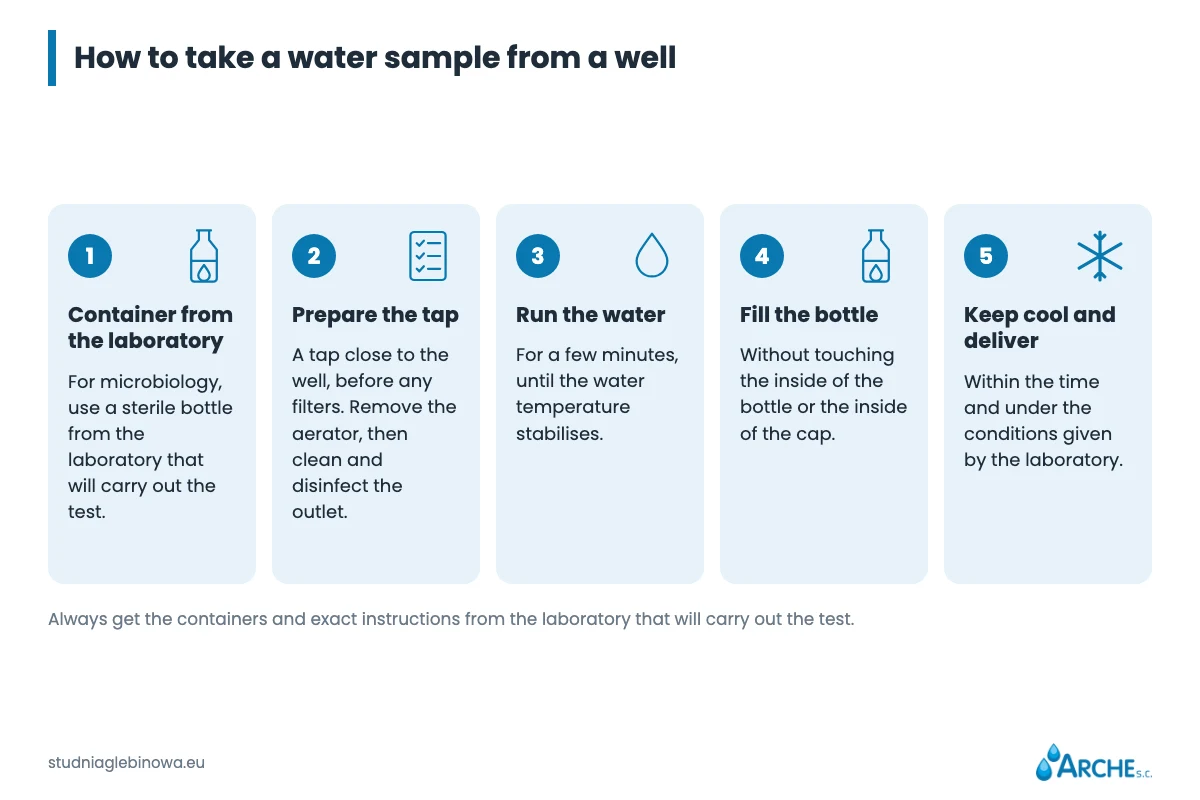
A badly taken sample gives a false result, especially in microbiology. General rules:
- Get the containers from the laboratory. A microbiological test needs a sterile bottle.
- Choose a tap close to the well, before any filters and treatment devices, unless you are testing the water after treatment.
- Remove the aerator, then clean and disinfect the tap outlet.
- Let the water run for a few minutes until the temperature stabilises.
- Fill the bottle without touching the inside of the bottle or the inside of the cap.
- Keep the sample cool and deliver it within the time given by the laboratory.
The laboratory always gives the exact instructions. Follow them rather than general advice from the internet.
Coliform bacteria found in the well: what next
- Stop drinking the water and using it to prepare food. Use a safe substitute supply.
- Find the cause: a leaking wellhead or well housing, flooding, a nearby septic tank, a damaged pipe.
- Fix the route by which contamination gets in. Without that, disinfection will only work for a short time.
- Have the well and the plumbing cleaned and disinfected. We describe doses and procedure in our article on how much chlorine to put in a well, and the service on the well cleaning page.
- After the treatment, carry out a follow-up test within the time agreed with the laboratory.
Boiling water kills bacteria, but it does not remove nitrates, metals or other chemical contaminants.
Frequently asked questions
How much does a well water test cost?
A package with microbiology and basic physicochemistry usually costs about PLN 300 - 900 at laboratories. Individual parameters are cheaper. The price depends on the scope, the region and whether the laboratory takes the sample.
How much does a water test at Sanepid cost?
It depends on the station. Some district sanitary and epidemiological stations test water for private individuals for a fee, according to their own price list, while others refer you to other laboratories. Ask the PSSE in your district.
How often should well water be tested?
After the well is completed, after every disinfection and repair, and, if the water is used for drinking, periodically as well. Agree the frequency with the laboratory on the basis of earlier results and the condition of the water source.
Is water from a deep well always clean?
No. A deep borehole gives better protection against contamination from the surface, but the water can contain iron or manganese, or be contaminated through a leaking wellhead. Only a test settles it.
What do coliform bacteria in a well mean?
Coliform bacteria indicate that contamination from the surface may have got into the water source. The presence of E. coli or enterococci means faecal contamination and water unfit to drink.
Sources
- Regulation of the Minister of Health of 22 May 2026 on the quality of water intended for human consumption, Journal of Laws 2026, item 748
- Sanepid: water from a private well, basic safety rules
- Sanepid: instructions for cleaning and disinfecting a well
- PWiK Wodzisław Śląski: laboratory test price list
- MPWiK Wrocław: laboratory services
Do you live in Lesser Poland or Silesia and want to have your water tested without searching for a laboratory? Order sampling and testing or call: +48 784 038 407. We will also help you interpret the result and plan the next steps.
