


Deep well yield and water inflow into the well: measurement, causes of decline, what to do
Deep well yield is the amount of water an intake can supply per unit of time, usually in litres per hour, without the water level dropping too far. It is measured by a pumping test with the water level recorded, not by the flow from a tap. There is no single minimum value for every house: what counts is daily consumption, peak demand and how quickly the water level recovers after pumping. When the water suddenly runs short, first check the installation in the house, then the water level, and only last the well screen.
Deep well yield: what it means and how to measure it
Well yield is the result of a pumping test recorded under specific conditions: at what flow rate, for how long and how far the water level dropped. The bare statement “there is water” does not say how much can be drawn.
Four quantities come up when assessing a well, and they must not be mixed up:
| Quantity | What it describes |
|---|---|
| Borehole depth | The distance from the reference point to the bottom of the well, not the lift height of the pump |
| Static water level | The water level in the well after a sufficiently long rest, with no pumping |
| Dynamic water level | The water level at a given flow rate and pumping time |
| Yield from pumping | The flow achieved under the recorded test conditions |
Measure the static and dynamic water levels from the same point, for example from the top edge of the casing. Measuring from ground level and from the protruding pipe gives different figures, even though the water stands in the same place. The Help Centre describes the same principle in the guide well yield and pumping tests.
A full pumping test should be carried out by the contractor: it includes measuring the discharge, the water level over time and the recovery of the water level after the pump is switched off. You can do a simple comparative check yourself:
- Switch off the pump and wait for the water level to stabilise. Measure its depth with a weight on a string from a fixed point, for example the top edge of the casing, and note the date.
- Start drawing water in the usual way for your house, for example watering the garden, and note how long it lasted.
- Measure the water level again straight after the draw-off ends. The difference is the drawdown at that rate of abstraction.
- Switch off the pump and note how long it takes for the water level to return to the level from step 1.
- Repeat the measurement in similar conditions in a few months and compare.
Do not run the pump at maximum draw-off until it starts sucking in air, because dry running destroys the pump. A single measurement is not a promise that the well will give the same amount of water in every season. That is why it is worth keeping the result from the well’s acceptance as a reference point for the future.
Minimum deep well yield: how much water a house needs
The minimum yield depends on daily consumption and peak demand, not on a single figure given in a guide. An intake with a lower steady inflow can work properly with a suitably sized storage tank, while a high-yield intake will not help if the pump is badly matched.
The table shows indicative assumptions for daily demand. They do not come from official standards, and actual consumption depends on the house and the garden. The third column is simple arithmetic: how many litres per hour it works out to if the draw-off were spread evenly over the whole day.
| Scenario | Example consumption | Average per hour with draw-off over 24 h |
|---|---|---|
| One person, no garden | 150 l/day | approx. 6 l/h |
| Family of 4, no garden | 600 l/day | 25 l/h |
| Family of 4 and a 500 m² garden in season | 1600 - 2600 l/day | 67 - 108 l/h |
| Family, garden and swimming pool in season | 2500 - 4000 l/day | 104 - 167 l/h |
The averages are low, but water is not drawn evenly over the whole day. What decides the required yield is peak demand: if the garden needs 1600 litres and you water it for 2 hours, the well must deliver at least 800 l/h for those 2 hours. That is why the question about minimum yield is worth turning into two questions: how much water do I draw at once, and for how long?
A pressure tank smooths out short peaks, but it cannot replace inflow when the draw-off lasts for hours, for example when filling a swimming pool. We describe how to match the equipment to the well’s results in the articles on the submersible pump for a deep well and the pressure tank for a well. A more powerful pump will not by itself increase the inflow to the well.
For abstraction larger than domestic use, the law also matters. The limit of 5 m³ per day is calculated as an annual average and applies to the needs of your own household or farm (Article 33 of the Water Law Act, consolidated text Dz.U. 2026 poz. 1335). Where the water serves a business, relying on ordinary use of water is usually not enough, so the procedure must be checked with Wody Polskie.
No water in a deep well: what to check, step by step
A lack of water does not always mean the well has failed. Start at the place where the problem shows and work towards the intake, because the cheapest causes are usually in the house.
- Check whether water is missing at all taps or only at one point or after a filter. A problem only after a filter is usually a clogged cartridge, not the well.
- Note the pressure gauge reading and the controller message, and check whether the unit shows running, standby or an alarm.
- Note when the problem began: suddenly, after prolonged pumping, after a change of settings or after switching on an additional irrigation zone.
- Check the pressure tank. If the pump switches on every few seconds and water comes out instead of air when you press the valve on the tank, the diaphragm is damaged. That is a fault in the installation in the house, not in the well.
- Measure the water level and compare it with an earlier measurement. If the pump is running and there is no water, or the flow disappears after prolonged draw-off, the water level may have dropped below the pump intake.
- Look at the water: cloudy water or water with sand points to a damaged screen or a washed-out gravel pack, as explained below.
What not to do as a trial: do not keep the pump running despite dry-run alarms, and do not replace the pump with a more powerful one without measurements. Do not assume either that deepening the well will solve the problem, because that decision requires an assessment of the construction and condition of the intake. The guide no water and yield in the Help Centre describes how to report the problem and what data to prepare.
A dry-run sensor switches off the pump when the water level falls below a safe level. It protects the pump from running dry, so it is worth having in a new installation. You can do the simple steps yourself: measuring the water level, checking the pressure tank and observing the water. Leave pulling the pump, cleaning the screen and camera inspection to a company with the right equipment: a failed attempt, for example snapping a pipe in the well, can cost more than a service call.
Water inflow into a deep well: why it weakens
Weak water inflow into a well most often results from the well screen being clogged with sediment, a drop in the water level in the aquifer, or pump wear. Rarer causes are added to these: sand pumping, corrosion of old pipes and faults in the pressure tank.
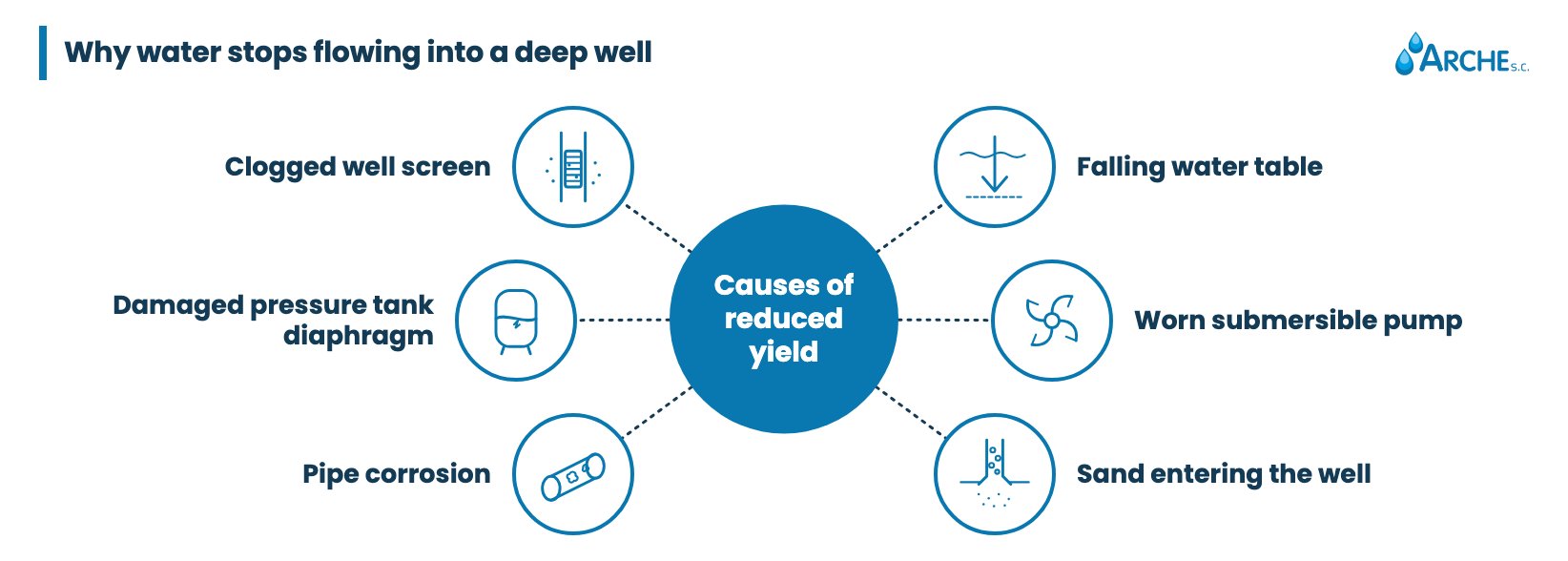
Screen clogging is the gradual blocking of the slots with deposits of iron, manganese, calcium carbonate and fine sand. The screen loses permeability, so at the same draw-off the water level drops lower than it used to. It progresses faster in water rich in iron, because the deposit builds up more quickly.
A lower water level in the aquifer gets worse during long droughts. A pump hung at a fixed depth then starts working close to the water level or above it and sucks in air instead of water. Heavy abstraction in the area can have a similar effect, because neighbouring wells draw on the same layer.
Wear of a submersible pump shows as a weakening flow, more noise and higher current draw, because the impeller wears down. A pump running in sandy water wears out noticeably faster than in clean water.
Sand pumping, that is sand in the water, is a sign of a damaged screen or a washed-out gravel pack. Sand quickly destroys the pump impeller, so at the first sign reduce the draw-off and arrange a camera inspection. If sand appears together with sudden subsidence of the ground around the casing, also see the article on sand in well water.
Corrosion of casing pipes affects older wells with steel fittings. Perforations in the pipe let in silt and sand from higher layers. In new boreholes ARCHE uses PVC-U pipes, so this problem mainly concerns old steel casings.
A damaged pressure tank diaphragm makes the pump switch on every few seconds. This looks like a drop in well yield, although the problem lies in the above-ground installation. Frequent starts shorten the life of the pump, which is why this is the most urgent and cheapest fault to eliminate.
Symptom, cause, what to do: a diagnostic table
Each symptom points to a different source of the problem and a different way of fixing it. The table lists them starting with the most common.
| Symptom | Probable cause | What to do |
|---|---|---|
| Weak flow, low pressure | Screen clogging or a worn pump impeller | Camera inspection, well cleaning, or checking and replacing the pump |
| Pump switches on every few seconds | Damaged pressure tank diaphragm or incorrect pre-charge pressure in the tank | Check the tank, replace the diaphragm or the pressure tank |
| Sandy, cloudy water | Damaged screen or washed-out gravel pack | Reduce draw-off, camera inspection, repair the screen or drill a new borehole |
| No water after prolonged pumping, pump sucks in air | Lowered water level or pump hung too high | Measure the water level, assess where the pump hangs, decide whether to change it |
| Noisy pump operation, vibration | Worn bearings, cavitation, loose mounting | Check and repair or replace the pump |
| Water disappears only after a filter | Clogged filter cartridge | Replace the cartridge |
When diagnosing, remember that several causes can occur at once, for example a worn pump in a well with a clogged screen.
Water inflow into a concrete ring well and a dug well
A concrete ring well usually draws from a shallower layer and reacts more strongly to the weather than a deep borehole. After a dry summer it has less water, and after rain more, because its inflow depends on the groundwater level in the area.
Different things contribute to weak inflow here than in a drilled borehole:
- a silted bottom that covers the water inlet,
- a fall in the groundwater level after a drought or after drainage works nearby,
- a pump hung too shallow, which quickly reaches the water level during draw-off,
- an increase in demand, for example after the garden has been extended.
Start with an inspection: measure the water level, check the depth of the well and the amount of sediment on the bottom. The scope of work on a particular well is set after looking at it. Deepening an old concrete ring well does not always make sense, and ARCHE deepens only new boreholes, not old concrete ring wells. We write more about when deepening makes sense and when a new borehole is better in the article on deepening a well.
What next: cleaning, rehabilitation or a new borehole
If the diagnosis points to a clogged screen, the first step is usually a camera inspection and well cleaning. Rehabilitation, that is restoring the permeability of the screen and the layer around it, works when the casing is in good condition and the aquifer itself has not run out of resources. We describe the methods and scope of such work in the article on well rehabilitation.
Rehabilitation will not help when the pipes are corroded through, the screen is broken or the aquifer has been depleted. In that case a new borehole is considered. Signs that it is worth going in that direction:
- the well is old and has steel pipes with perforations,
- the problem returns despite repeated cleaning,
- the water level measurement shows a lasting decline rather than seasonal fluctuations.
For cleaning a deep well, ARCHE charges from PLN 1,500 net, on average PLN 2,000 net, and a borehole up to 30 m costs PLN 9,000 net, with each additional metre at PLN 250 net. These are prices from the company price list, net amounts. The result of cleaning depends on the condition of the well, so we do not promise in advance that the yield will return in full. If you want someone to look at the well and assess the cause, see the deep well cleaning service.
How to prevent a drop in deep well yield
A drop in yield usually builds up slowly, so the best protection is regular measurement, not waiting for a failure. A few habits help:
- once a season, measure the water level and the recovery time after pumping, always from the same point and in similar conditions,
- every year, check the pump and the installation: pressure, the operation of the pressure tank and the condition of the diaphragm,
- arrange a camera inspection from time to time to see the condition of the screen and pipes before clogging causes a noticeable drop,
- test the water regularly: the State Sanitary Inspectorate (Sanepid) recommends testing well water before first use and at least once a year, and also after flooding or a fault; a rising iron concentration foreshadows faster clogging of the screen,
- keep a well log with the dates of inspections, test results, yield measurements and part replacements.
A log makes diagnosis easier, because it shows whether the decline is steady or seasonal. The right intervals between these tasks depend on the well and the water quality, so agree them with the contractor.
The amounts given in the text are ARCHE prices in the net version from the price list. The graphic is illustrative and does not replace a design, a geological survey or a diagnosis of water quality.
If you recognise the symptoms described here and want to establish the cause, contact an ARCHE expert. You can also call: +48 784 038 407.
Frequently asked questions
How much water per hour should a deep well provide?
There is no single value for every house. The required yield depends on daily consumption and peak demand, that is, on how much water you draw at once and for how long. Choosing it requires a water balance and the results of a pumping test.
How can you increase deep well yield?
First establish the cause, because a more powerful pump will not by itself increase the inflow. When a clogged screen is to blame, a camera inspection and cleaning help. When the water level has dropped, the position of the pump and the condition of the aquifer need to be assessed. If the pipes are ruined, a new borehole is what remains.
Can a deep well run out of water?
Yes. In a long drought with heavy abstraction in the area, the water level can drop far enough for the pump to start sucking in air. Measuring the water level once a season will show the trend before the water runs out.
How quickly does a well recover its water level after pumping?
The recovery time depends on the aquifer and the condition of the screen. After the pump is switched off, the water level returns to its resting level, and a longer return than before signals an inflow problem, for example clogging. It is best to compare with the measurement taken when the well was accepted.
What does sand in the water from a deep well mean?
It is a sign of a damaged well screen or a washed-out gravel pack around it. Sand destroys the pump impeller, so reduce the draw-off and arrange a camera inspection. The sooner you react, the less damage the pump suffers.
Why does a submersible pump switch on every few seconds?
Most often it means a damaged diaphragm in the pressure tank, not a fault in the well. Check the valve on the tank: if water comes out of it instead of air, the diaphragm needs replacing. Frequent starts shorten the life of the pump.
Sources
- Prawo wodne, consolidated text Dz.U. 2026 poz. 1335 (ISAP Sejm): Article 33 on ordinary use of water and the limit of 5 m³ per day.
- Wody Polskie, frequently asked questions: abstraction of groundwater requires a water-law permit, with an exception for ordinary use of water up to 5 m³ per day as an annual average.
