


Drilling a well yourself: methods, risks and limits
Drilling a well yourself is possible to a depth of about 8 - 10 metres, but only in soft ground: in sand and light clay without stones. It is done with a hand auger, with the percussion method or by driving in a pipe, as with an Abyssinian well. There is no certainty that you will reach the aquifer, and a borehole without casing can collapse. When the water lies deeper, the ground is hard or the well is to be the only source of drinking water, the borehole should be commissioned from a company with a mechanical drilling rig. Legal position as at 16.11.2026.
Is drilling a well yourself possible?
Yes, but only in certain conditions. Doing it yourself is realistic when the ground is soft (sand, sand with a little clay, light clay without stones and rock) and the water lies shallow, at 8 - 10 metres or less. It is worth confirming the depth of the aquifer with neighbours who have their own wells. The well should also serve mainly for household purposes, meaning watering and washing, rather than as the only source of drinking water. Difficult access to the plot, which rules out heavy equipment, is sometimes an additional argument.
Doing it yourself is unrealistic or dangerous when the ground is rocky, gravelly or full of stones, when the aquifer lies deeper than 10 metres, or when you know nothing about the geology of the site and are drilling blind.
Manual well drilling is hard physical work that usually takes several days. You need strength, patience and at least one helper.
Manual well drilling: three methods
The three methods differ in the cost of equipment, the strength required and the type of ground they can get through. The choice depends on what you have underground.
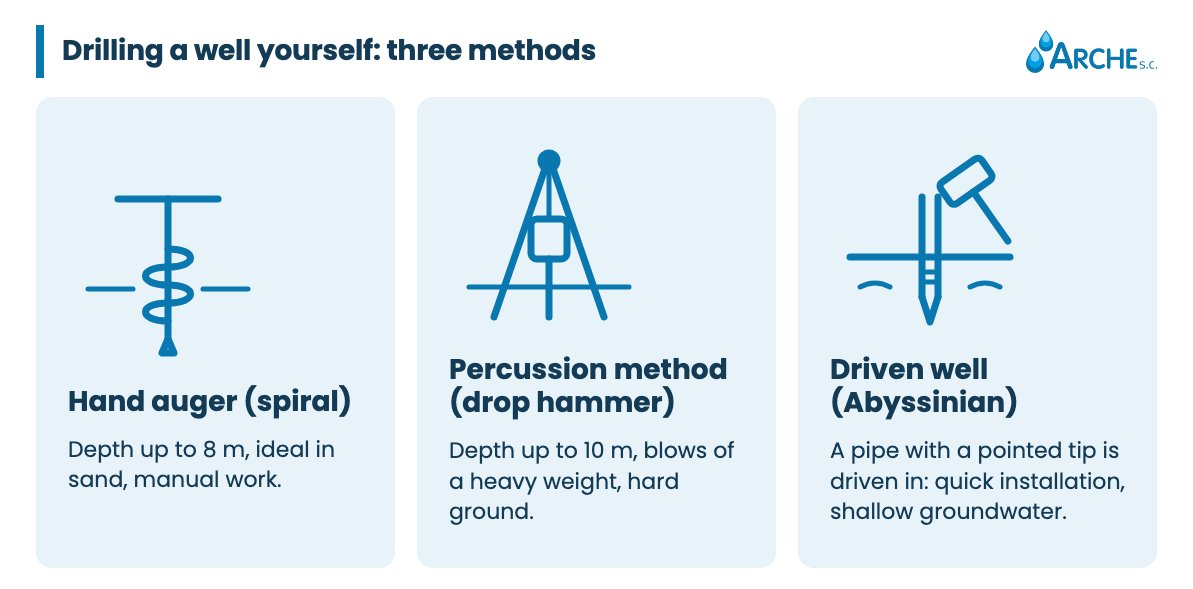
Hand (spiral) auger to 8 m in sand
The most popular method is the spiral auger, which is turned by hand with a handle and brings the spoil to the surface as twisted curls of soil. A complete set is a soil reamer, two bits (a smaller and a larger one, for example 160 mm and 180 mm), 1 m extension rods, a handle with a crossbar, a flap-valve bailer for liquid spoil and a rope with a carabiner. The PVC pipes for lining the borehole are usually 110 mm or 125 mm in diameter, so the bits must be wider than they are.
The procedure goes like this:
- Dig a starting hole 30 - 40 cm deep.
- Fit the reamer with the larger-diameter bit and turn it clockwise. Every 5 - 10 turns, pull the auger out with its spoil.
- Once you reach a depth of one metre, attach a safety rope to the bit and screw on the first extension. Add the next rod with every further metre.
- In wet ground, close to the aquifer, switch to the flap-valve bailer to remove the liquid material.
- Once you have drilled into the aquifer, fit the casing with a mesh screen at its lower end.
A spiral auger will not get through stones, hard clay or rock. The pace of work is roughly 1 - 3 metres a day in soft sand, and in clay it drops to 0.5 - 1 metre a day.
Percussion method (drop-weight rig) to 10 m
The percussion method is an alternative to the auger in denser ground. A heavy steel pipe with sharp edges (a cutting shell) is lifted and dropped sharply, taking in soil that is then removed from the inside. You need a tripod with a winch to lift the pipe. It can be built from wooden beams with a cross-section of at least 15 x 15 cm, or from steel pipes.
The advantage over the spiral auger is getting through denser clay and fine gravel, where the auger stops. The drawbacks are the noise, the slower pace and the need to build a stable structure that will bear the weight of the pipe being struck. The realistic maximum depth is usually 8 - 10 metres, and in practice often less. The pace is 0.5 - 2 metres a day, depending on the ground.
Abyssinian (driven) well as the simplest option
The fastest and cheapest method is driving in a thin steel pipe 32 - 50 mm in diameter, finished with a conical point, without actual drilling. A mesh screen at the end of the pipe lets water in and holds back soil particles. You reach a depth of 3 - 8 metres this way, and the water is drawn with a hand pump (no electricity needed) or a small suction pump, effective to about 7 - 8 metres.
The yield of such a well is unstable and can drop in summer, because the water comes from a shallow layer. The pipe will not get through stones. Water from a shallow layer is also of poorer quality and is not fit to drink without testing and treatment. The ideal scenario is a leisure plot and watering the garden. We describe the construction and limitations in detail in a separate article on how a driven well (Abyssinian well) works.
Digging a well or drilling a well
Digging a well is a different technique from drilling: a wide shaft is dug by hand and lined as you go, usually with concrete rings. Such a well reaches shallow groundwater, so its quality and yield depend on the season and on what happens on the surface of the plot, for example near a septic tank or fertilisers.
If you are wondering how to dig a well yourself, remember the risk. A deep excavation in ground without lining can cave in, and the person at the bottom is then in danger. That is why manual digging only makes sense with very shallow water and with a second person standing by. You will find a comparison of the two solutions, their advantages and drawbacks, in the article dug well or drilled well.
How much drilling a well yourself costs
Drilling it yourself means buying equipment and materials, and then there is the pump. The amounts below are indicative values for equipment from well-supply shops and auction sites. Check current prices before you buy.
| Item | Indicative cost |
|---|---|
| Set with a hand auger, bailer and extension rods | PLN 500 - 1,200 |
| Percussion method equipment (cutting shell, tripod, ropes, winch) | PLN 800 - 2,000 |
| Materials for an Abyssinian well | PLN 300 - 800 |
| 110 mm PVC pipes, mesh screen and gravel for the gravel pack | PLN 200 - 800, depending on depth |
| Pump | PLN 300 - 1,500 |
In total, a well up to 8 metres drilled with a hand auger usually costs PLN 700 - 2,000 without the pump. With the percussion method the total can reach about PLN 2,800. On top of that come the water test and any treatment.
For comparison, ARCHE prices a borehole up to 30 m at PLN 9,000 net, and each further metre at PLN 250 net. The price includes the equipment, the well pipe and the gravel pack. If the borehole turns out dry, with no water, we charge PLN 150 net per metre. How borehole costs are calculated is explained in the guide well drilling price per metre.
How long drilling a well yourself takes and when to start
In soft sand with shallow water (3 - 5 m), drilling takes 1 - 2 days with a helper, including fitting the pipe and screen. In sandy clay down to 8 metres, count on 3 - 5 days of hard work, with breaks for pulling out spoil and adding water. On top of that come the preparation (buying equipment, checking the geology) and the finishing: installing the pump, pressure tank and connection. How long a company with a drilling rig takes is described in the article how long deep well drilling takes.
In winter, manual drilling is much harder, because the top layer of ground freezes and becomes hard, and the auger goes through it very slowly or not at all. In snowless winters with temperatures above 0°C it is possible, but it is better to wait until spring. A mechanical drilling rig works without any problem all year round.
Risks of drilling a well yourself
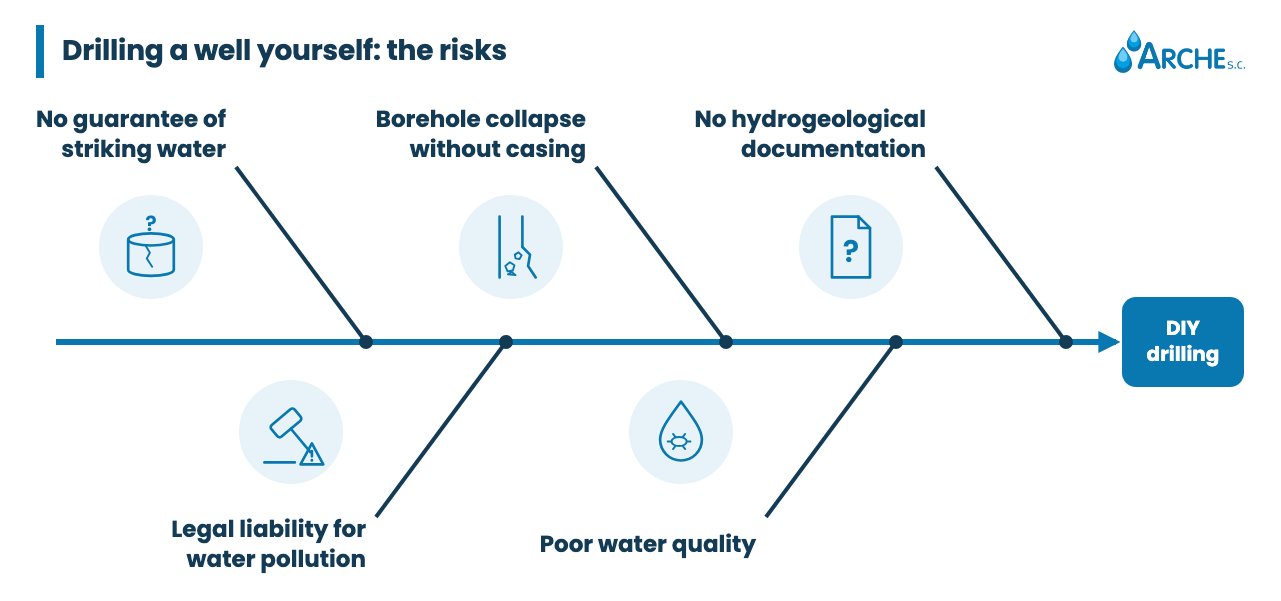
The lack of any guarantee of hitting water is the basic risk. You drill 8 metres, hit dry clay or impermeable rock, and lose the money spent on equipment and several days of work with nothing to show for it. A company knows the geology of the region and the data from nearby boreholes, which reduces this risk but does not remove it. No reputable contractor guarantees water.
Borehole collapse happens when the ground slips and fills the hole. You have to start again or abandon the location. Professionals insert the casing as they drill, and without experience it is hard to coordinate the pace of drilling with the pace of inserting the pipe.
No hydrogeological documentation means you do not know the thickness of the aquifer or what the yield will be. Choosing a pump without that knowledge is a lottery that can end in a breakdown after a week.
Liability for water contamination is a risk that is rarely mentioned. A leaking borehole can lead to water from different layers mixing and to contamination of a deeper aquifer that your neighbours use as well. A water installation built without the required consent carries a penalty, and a well can be legalised, as we describe in the article on legalising an illegal well.
Poor water quality affects shallow layers in particular, which are polluted by fertilisers and septic tanks. Without testing and filtration it is a health hazard for the whole family.
Physical injury is a risk that amateurs underestimate: a heavy percussion pipe, a taut tripod rope and work beside a deep hole. Without experience, an accident is a real possibility.
Drilling a well yourself versus a drilling company
The table below compares the two routes. The company column describes ARCHE, meaning the scope confirmed in our offer, not a general market average.
| Parameter | Doing it yourself | Drilling company (ARCHE) |
|---|---|---|
| Cost | equipment and materials PLN 700 - 2,800 plus a pump PLN 300 - 1,500 (indicative) | borehole up to 30 m: PLN 9,000 net, each further metre PLN 250 net |
| Drilling time | 2 - 5 days of hard work | depends on depth and ground, see the article on drilling time |
| Depth | 8 - 10 m, soft ground only | offer from 15 to 100 m |
| Method | auger, drop-weight rig or driven pipe | Rotomax XL GT drilling rig, percussion method, Atlas Copco XRVS compressor |
| Guarantee of water | none | none, but a dry borehole is charged at PLN 150 net per metre |
| Finishing | PVC pipe chosen on your own | PVC-U well pipes 125 mm (110 mm in sand), filter gravel pack, pumping test |
| Risk of borehole collapse | high without experience | the casing is pulled out after the well pipe is installed |
| Water quality | unknown without testing | water test after drilling as a separate service |
| Guarantee on the work | none | 2 years |
| Paperwork | the investor checks it alone | the investor is responsible for consents, the contractor advises what to check |
Drilling it yourself pays off for a garden, sand and shallow water (down to 6 - 8 m), when you need the water only for watering and you have the time and strength. With a deep intake, hard clay or drinking water, it is a waste of time and money.
Does drilling a well yourself need a permit?
Building a water intake up to 30 m for ordinary use of water is exempt from a water-law permit and notification, but this exemption has conditions, which we describe in the answer in the questions section below and in the article on whether a deep well needs a permit. The basis is the Water Law Act (Prawo wodne), in the consolidated text Dz.U. 2026 poz. 1335. If you dig or drill an intake without the required consent, you can legalise it with Wody Polskie. According to the Wody Polskie page on legalising a water installation, the unit rate of the legalisation fee in 2026 is PLN 6,601.67, and the rate is indexed.
When to commission a company to drill
Drilling it yourself is a bad idea whatever your budget when any of the following situations applies.
- The ground is rocky, gravelly or has large stones. The auger stops, and the percussion method reaches the limit of what it can do. You need a well drilling rig, which an amateur cannot operate.
- The aquifer lies deeper than 10 metres. By hand this is impossible, and in clay the work exceeds one person’s strength from just a few metres down.
- The well is to be the only source of drinking water for the house. It needs a borehole with the right pipe, screen and gravel pack, and a water test. The consequences of a mistake can be serious for health.
- The site lies in a water protection area, for example in the protection zone of a municipal intake or in a Natura 2000 area. Check the requirements with the municipal office and Wody Polskie.
- You need documentation, for example for an authority’s requirements or when selling the property.
- You have no knowledge of the geology of the site, so drilling would be a lottery.
- You need a high yield, for example for a business, a farm or irrigating a larger garden. A well up to 8 metres will not reliably give a large quantity of water all year round.
What drilling by a company looks like, step by step and with the regulations, is described in the guide deep well drilling. ARCHE drills boreholes in Lesser Poland (Małopolska) and Silesia, and you will find the details of the service on the page deep well borehole. You can check current prices in the deep well price list; the amounts in it are net.
How to prepare for drilling it yourself
The list below is for people who, having weighed the risks, decide to drill in favourable conditions.
- Check the geology. Ask your neighbours about the depth of their wells and the type of ground.
- Settle the location. The distances used until now under the repealed regulation on technical conditions are 5 m from the plot boundary, 7.5 m from the axis of a roadside ditch, 15 m from livestock buildings and the associated waste tanks, and 30 m from a drainage field pipe for treated wastewater. The regulation ceased to be in force in September 2026 and a new one has not yet been published, so settle the location with the designer and the district office (starostwo). More in the article on well distances.
- Buy or hire the equipment: a hand auger with its set, 110 mm PVC pipes, a mesh screen and a bailer.
- Plan the time with a helper. The minimum is several days of work with a second person at the surface.
- Collect soil samples from every metre, each in a separate bag with the depth written on it. Sand and gravel are permeable layers, good for the screen. Clay insulates, so you keep drilling.
- Install the casing as you go, every metre, not at the end of drilling.
- Once you have drilled into water, install the screen, backfill with gravel and pump out the dirty water until it is no longer cloudy. Then have the water quality tested in a laboratory before use.
How to read the costs given
The amounts given are indicative examples for budget planning, not a confirmed market average or an offer for every plot. Check the current scope and quote with the contractor. Include energy, water tests, servicing, treatment and a reserve for replacing equipment. When comparing offers, always establish the full amount payable and the scope of materials.
Frequently asked questions
Can you drill a deep well yourself?
You can make a shallow well to about 8 - 10 metres in soft ground yourself. A deep well drilled by hand in hard clay, gravel or rock has no real chance, because a mechanical drilling rig is needed. It is worth commissioning a company for a well for drinking water.
How deep can I drill a well by hand?
The realistic limit is 8 - 10 metres in soft sand or light clay, using a spiral auger or the percussion method. In dense clay you will usually reach 4 - 6 metres, because the resistance of the ground is high and the pace drops to 0.5 metres a day. Stones, coarse gravel and rock make manual drilling impossible from as little as 2 - 3 metres.
Does a hand-drilled well need to be notified?
Building a water intake up to 30 m for ordinary use of water, and abstraction not exceeding 5 m³ per day on annual average for your own household or farm, are exempt from a water-law permit and notification (Article 33 and Article 395 of the Water Law Act (Prawo wodne)). These are separate conditions covering the construction of the intake and the abstraction of water. A deeper borehole, or use of the water beyond ordinary use, requires checking the correct procedure with Wody Polskie. The exemption does not remove location requirements, the protection of water intakes or the geological regulations.
Is water from a hand-drilled well fit to drink?
The depth of the borehole, clarity and lack of smell do not confirm that the water is fit to drink. Before drinking it you need microbiological and physicochemical tests in a laboratory, and the scope of treatment is chosen to match the results. The State Sanitary Inspectorate (Sanepid) recommends testing well water before first use and at least once a year. If you suspect contamination, use another source of drinking water, because boiling alone does not remove chemical contaminants.
What should you do when the auger hits a stone?
With a small stone, up to 10 - 15 cm, you can try to bypass it by shifting the drilling axis, or break it with a chisel. With a large stone or a layer of gravel, a hand spiral auger stops and further drilling is not possible. Two options remain: abandon the borehole and start in another place, or call in a company with a mechanical drilling rig.
How much does drilling a well yourself cost?
A set with a hand auger costs roughly PLN 500 - 1,200, and the pipes, screen and gravel a further PLN 200 - 800, depending on depth. Together that usually comes to PLN 700 - 2,000 without the pump, and with the percussion method even about PLN 2,800. The full breakdown is in the table in the section on costs.
Sources
- Prawo wodne, consolidated text, Dz.U. 2026 poz. 1335 (checked 16.11.2026): Articles 33 and 395, ordinary use of water and exemptions
- Wody Polskie: legalizacja urządzenia wodnego, legalisation fee 2026 (checked 16.11.2026)
- Prawo geologiczne i górnicze, consolidated text, Dz.U. 2026 poz. 69: exclusions for boreholes up to 30 m
Instead of risking a dry borehole, you can ask us about building a well on your plot. Write to us or call: +48 784 038 407. We will assess the ground and the depth of the water and tell you whether manual drilling makes sense in your case.
