


A well and mains water on one property
You can plan to use a well and the mains on the same property, but the layout must protect the public water supply from backflow. Two manually operated valves are not in themselves proof of a safe connection.
First define the outlets
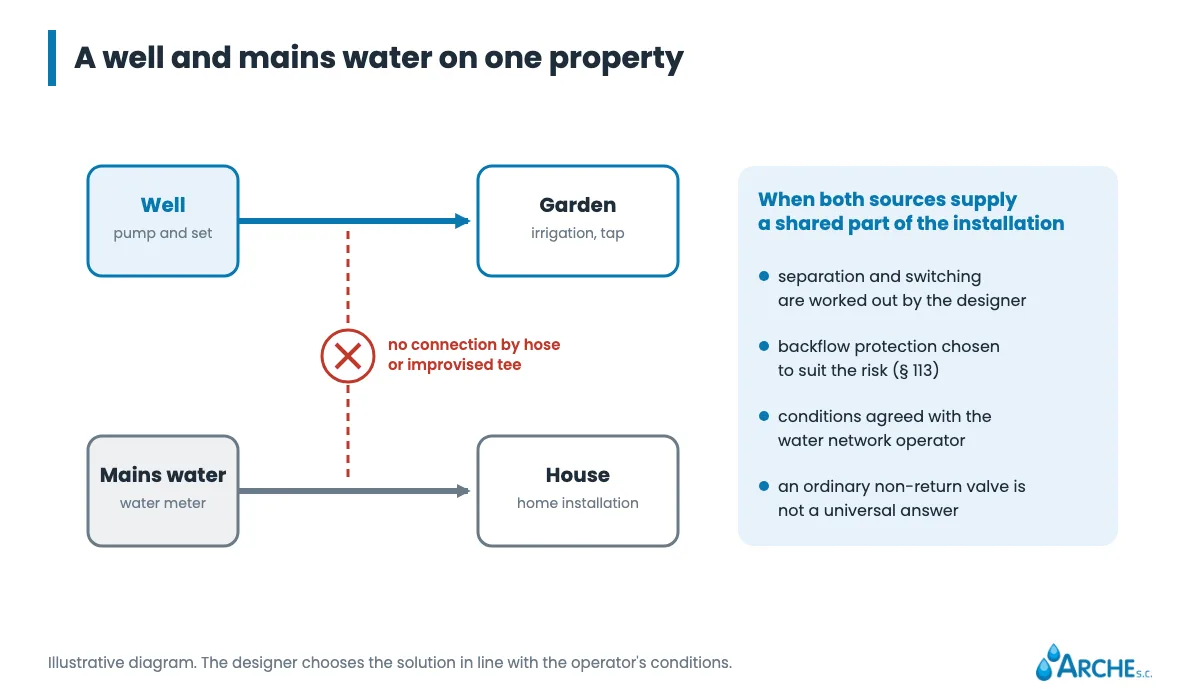
Write down which points will receive water from the well and which from the mains. A common arrangement is a separate garden on the well and the house on mains water. Mark the sources on the sketch and label the fittings clearly.
If both sources are to supply a shared part of the installation, the designer should work out how they are separated and switched. The operator's conditions and protection appropriate to the actual risk must be agreed. Do not treat an ordinary non-return valve as a universal answer.
What follows from the installation requirements
The technical conditions require the installation to be protected against secondary contamination of water by backflow. Choosing a specific solution is not a matter of adding a symbol to a diagram. The basis is, among others, § 113 para. 7.
Calculate wastewater separately
If water from the well ends up in the sewer after use in the house, ask the operator how the amount is determined, whether metering is needed and what the contract terms are. In your savings calculation, use the actual charging rules.
Do not deduct your whole water and sewage bill as savings. Some costs may remain, and a well adds energy, testing, servicing and possibly water treatment.
Handover and later changes
At handover, ask for the documentation of the system and for a demonstration of how to tell which source is active. Adding a tap, irrigation or a filter bypass later should also keep the required protection.
Keep the operator's agreements together with the description of the installation. Do not modify the system yourself using a hose or an improvised tee.
Sources:
Checked 8 October 2026