


Dug well or drilled well: which to choose and when
Dug well or drilled well? For watering a garden and for an allotment with small water use, a dug well (concrete rings), which draws from a shallow water layer, is usually enough. For water for a whole house, especially drinking water, a drilled well is better, because it reaches deeper and is sealed by a pipe. Below you will find a table, a description of both options and the situations in which each makes sense. Legal position as at 16.11.2026.
Dug well or drilled well: comparison table
The most important difference is the purpose: a dug well suits utility water, a drilled well suits water for a whole house. The table compares the two wells on the parameters that most often decide the choice.
| Parameter | Dug well (concrete rings) | Drilled well (deep well) |
|---|---|---|
| Depth | a few to a dozen or so metres, the first water layer | from a dozen or so metres, down to a layer chosen to suit the ground (ARCHE boreholes: 15 - 100 m) |
| Construction | an excavation and concrete rings, open water surface | a hole with a PVC pipe, a screen and a gravel pack, water surface enclosed by the pipe |
| Water quality | exposed to surface contamination, needs testing | from a deeper layer, testing is still needed |
| Dependence on weather | the water level drops during drought | usually more stable, but depends on the layer the borehole reaches |
| Construction work | possible to do yourself, observing health and safety rules | needs a drilling rig and a crew |
| Pump | submersible or surface | submersible pump |
| Typical use | garden, seasonal allotment, utility water | house, farm, business, drinking water after testing |
| Cost | depends on the depth, the excavation and the rings, with no reliable market average | a borehole at ARCHE up to 30 m: PLN 9,000 net, each further metre PLN 250 net |
The full price list for boreholes is on the page deep well price list. We do not give the cost of a dug well as a figure, because we have no reliable source for it. It depends on the depth, the ground, the number of rings and whether you do the excavation yourself or commission it.
What a dug well is and how it works
A dug well is a shaft lined with concrete rings that draws water from the first, shallowest aquifer. Water enters through the bottom, which has a gravel bedding, or through openings in the rings, that is, by lateral inflow.
It used to be the basic way of obtaining water. Today it serves mainly where drinking water is not needed: for the garden, washing and utility purposes. Because the water surface is open and the water comes from a layer close to the surface, the well needs a tight cover and sealed rings. The yield of a concrete ring well depends on how much water flows into the shaft and how that changes through the year. We describe this separately in the article on deep well yield and water inflow. A pump is used to supply a house from such a well, and the article on the pump for a concrete ring well describes how to choose one.
How to build a concrete ring well step by step
A concrete ring well can be built yourself, but it takes precision, especially when sealing the rings, because the quality of the water years later depends on it. The order of work is as follows.
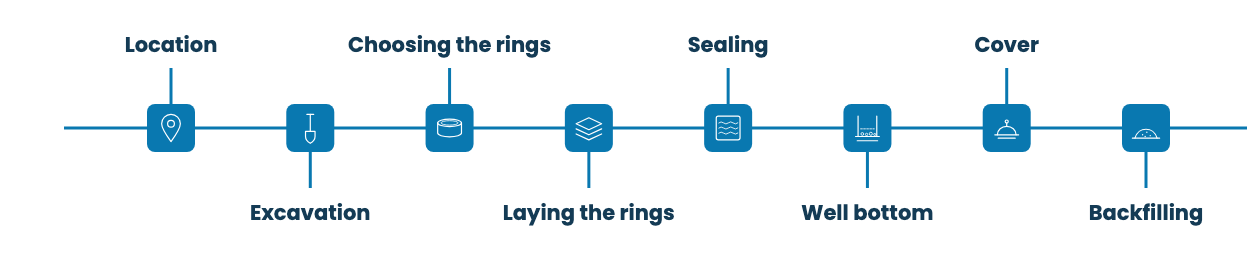
- Location. Choose a spot away from the septic tank, waste tanks and livestock buildings, and check the local plan before digging. Ask your neighbours about the water level, because a dug well can lower the water level on a neighbouring plot if both draw from the same shallow layer.
- Excavation. The diameter of the excavation is slightly larger than the rings. When working in the excavation, someone has to be at the surface, and spoil should be piled away from the edge.
- Choosing the rings. Buy rings from a manufacturer with quality documents. They come as solid rings, rebated rings and filtering rings (with openings for lateral inflow).
- Laying. The first ring rests on a cutting ring, and the following ones are joined with waterproof mortar or a bentonite gasket. Check that the shaft is plumb at every ring.
- Sealing. The joints are sealed from the inside along the full height, and from the outside working from the surface downwards. A leak is a path for contamination from the ground.
- Well bottom. A gravel bedding or a perforated slab with a layer of washed sand.
- Cover. Tight, with a closure that keeps out insects and animals. The last ring stands above ground level, and for a well drawn by hand it should be higher.
- Backfilling. The space behind the rings is filled in layers and tamped so that the ground does not settle.
Sealing is the most common weak point of concrete ring wells. During construction, a bentonite gasket is used, which swells in contact with water and fills the gaps, along with waterproof mortar. In an existing well with leaks, the joints are sealed from the inside with special water-stopping mortars. The most common causes of leaks are missing gaskets at construction, damaged rings and ground movement in frost.
If you are thinking of digging it yourself, remember that this is a separate decision from drilling. We write about drilling a well yourself in the article drilling a well yourself.
What a drilled well is and how it works
A drilled well is a hole made with a drilling rig, containing a pipe with a screen, and a submersible pump supplies water to the house. It reaches an aquifer lying deeper than the water in rings and is sealed by a pipe, so the water has no contact with the surface.
ARCHE boreholes use PVC-U well pipes of 125 mm, and in sandy ground 110 mm with a thicker filter gravel pack. The rig is a Rotomax XL GT with an Atlas Copco XRVS compressor, and the method is percussion. A pumping test is carried out at the end, and the company gives a 2-year warranty. We describe the construction and the course of the work in the article on a drilled well, so here we stay with the comparison with a dug well.
When to choose a dug well
A dug well makes sense when the water is used mainly for the garden and utility work, not for drinking. It is most often chosen in these situations:
- the water is to be used for watering, washing and utility purposes,
- the house already has mains water, and the well is only a supplement for the garden,
- the plot is a recreational one, without electricity, and water is drawn by hand,
- a shallow water level has been confirmed, for example at the neighbours’,
- the intake will be used seasonally, from spring to autumn,
- you want to build the well yourself to cut labour costs.
For watering alone on sandy ground, an even simpler solution is sometimes enough, namely an Abyssinian well. A dug well is not a good sole source of drinking water for a house: water from a shallow layer is exposed to fertilisers, leaks from faulty septic tanks and runoff after rain.
When to choose a drilled well
A drilled well is chosen when it is to be the main source of water for a house, farm or business. It works well in these situations:
- the house has no mains water, or the connection is expensive and it is worth comparing the two costs (the local water utility will price the connection),
- a constant supply is needed, for example for a farm or for watering livestock,
- the water is to be drinkable and the intake should draw from a layer isolated from the surface (quality is confirmed by a water test in any case),
- the water lies deeper than a concrete ring well reaches,
- the intake is to serve for years with minimal maintenance,
- the water is needed by a business or a service premises.
No honest contractor will guarantee water at a particular depth: the result is shown only by drilling and a pumping test. If you are thinking about a borehole, see the service page deep well drilling. The answer to how long and how deep depends on the plot.
Water inflow and drought: does a dug well dry up
Yes, a dug well can run dry, because the first aquifer depends on rainfall. During drought the water level can fall below the bottom of the shaft, and there is no water for weeks. A pump running dry can be damaged. If the well is shallow and you will need water in summer, the risk is high.
When the water disappears, deepening is sometimes an option. We describe how it works in the article deepening a well. ARCHE deepens only new boreholes, not old concrete ring wells. A drilled well reaches a layer chosen to suit the ground, so it usually reacts less to seasonal swings, although here too the yield has to be checked with a pumping test.
Whether a permit is needed: dug and drilled wells
Water-law requirements depend on the depth of the intake, the quantity of water abstracted and its intended use, not on the name of the type of well. The key sentence from the Water Law Act (Prawo wodne), consolidated text Dz.U. 2026 poz. 1335, reads as follows:
Constructing an intake up to 30 m for ordinary use of water, and abstraction not exceeding 5 m³ per day on annual average for the needs of your own household or farm, are exempt from a permit and from a water-law notification (Article 33 and Article 395 of the Water Law Act). These are separate conditions concerning the construction of the intake and the abstraction of water. A deeper borehole, or using the water beyond ordinary use, requires checking the correct procedure with Wody Polskie. An exemption does not remove location requirements, protection of intakes or the geological regulations.
The full description is in the article deep well permit. A dug or drilled well built without the required consent can be legalised: the owner of an intake built before 18.08.2026 who submits a complete legalisation application by 31.12.2027 is exempt from the legalisation fee (Article 524a of the Water Law Act). Details are on the Wody Polskie page on legalising a water installation.
The distance of a well from the boundary, the septic tank and buildings: the previous regulation on technical conditions ceased to apply in September 2026 and the new one has not yet been published, so we set distances from the boundary, the septic tank and buildings with the designer and the district office (starostwo), based on previous practice and draft regulations. The values applied until now include 5 m from the plot boundary and 15 m from tanks connected with livestock buildings, but they are not a regulation in force today.
Whether water from a dug well is drinkable
Water from a dug well is rarely fit to drink without testing, and often without treatment. The first water layer is exposed to bacteria, nitrates and plant protection products. For drinking water, the parametric value for nitrates is 50 mg/l, and for E. coli and enterococci it is 0 per 100 ml (Minister of Health regulation of 22.05.2026, Dz.U. 2026 poz. 748).
Testing a private well is recommended, not mandatory: the State Sanitary Inspectorate (Sanepid) recommends it before first use and at least once a year, and also after flooding or a failure. We do not make diagnoses from the appearance of the water alone, and the laboratory decides on the assessment.
The most common mistakes when choosing a well
The most common mistake is digging a well as the only source of drinking water for a house. The second is failing to seal the rings, which spoils the water quality after a year or two. Others:
- choosing cheap rings without quality documents,
- too much abstraction from a shallow well in summer and the pump running dry,
- drilling without investigating the conditions in the area,
- failing to check whether the intake needs consent (deeper than 30 m or for a business),
- no water test after construction.
Frequently asked questions
Can I dig a concrete ring well myself?
Yes, a dug well can be built yourself, without a specialist drilling rig. You need strength, knowledge of health and safety rules and equipment for lowering the rings. Pay the most attention to sealing. A drilled well is not something you build yourself, because it needs a drilling rig and a crew.
Is water from a dug well fit to drink?
Rarely without testing. Water from a shallow layer is exposed to contamination from the surface, so before drinking it has to be tested in a laboratory and often treated. The test result will show whether and what needs to be done.
Can a dug well run dry in summer?
Yes, because the first water layer depends on rainfall and in a drought the water level can fall below the bottom. A drilled well reaches deeper, so it usually reacts less to drought, but the yield is checked with a pumping test.
What permits are needed for a dug and a drilled well?
It depends on the depth, the purpose and the quantity of water abstracted. An intake up to 30 m for the needs of your own household or farm, and abstraction of up to 5 m³ per day, are exempt from a permit and from a water-law notification. For a deeper borehole or water for a business, check the procedure with Wody Polskie.
Can you have a dug well and a drilled well on one plot at the same time?
Yes, it is a common arrangement: the drilled well supplies the house, and the dug well serves the garden and utility work. When siting both, agree the distances with the designer and the district office (starostwo), because the previous regulation ceased to apply in September 2026.
Sources
- Prawo wodne, consolidated text Dz.U. 2026 poz. 1335 (Article 33, Article 395, Article 524a)
- Rozporządzenie Ministra Zdrowia z 22.05.2026 (quality of water intended for human consumption), Dz.U. 2026 poz. 748
- Wody Polskie: legalizacja urządzenia wodnego
If the comparison points to a borehole, write to an ARCHE expert or call: +48 784 038 407. We will check the conditions on your plot.
